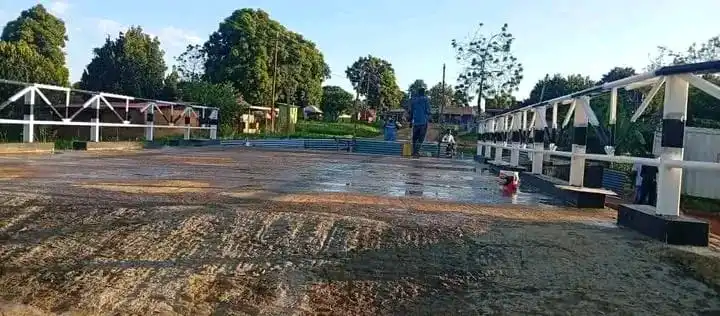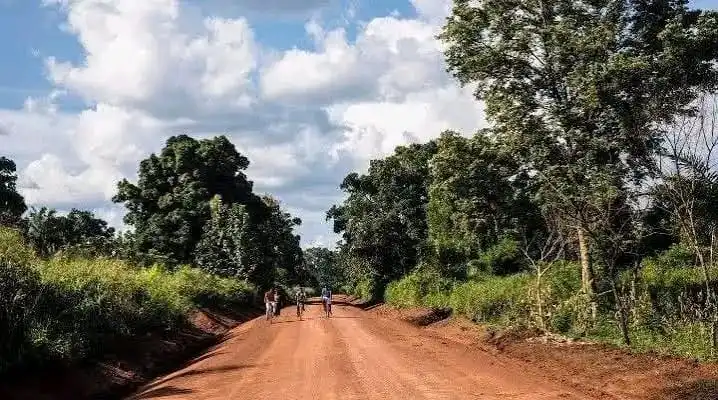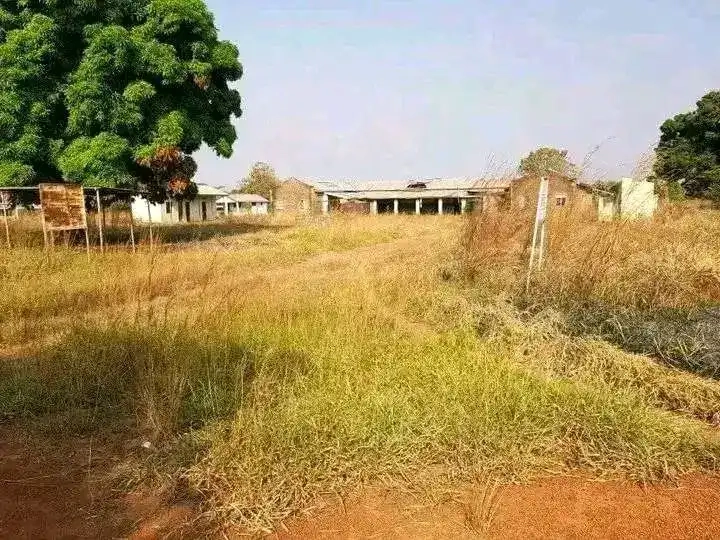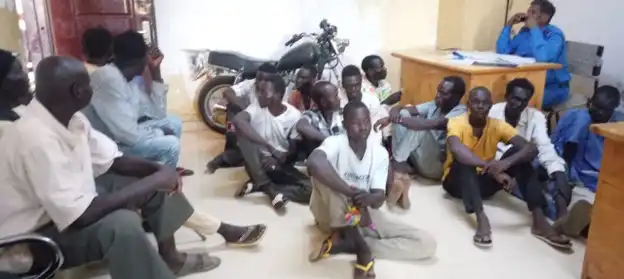
Facing Forced Return: South Sudanese citizens remain under security guard in Sudan after being arrested and convicted for residency violations. With heightened crackdowns on foreign nationals across the country, many now face an uncertain future as they await deportation. Courtesy Photo
For three days, 23-year-old Gathiang Manytuel floated helplessly in the blue waters of the Mediterranean Sea after an overcrowded boat carrying him and 63 other migrants broke down while attempting to reach Greece from Libya.
His legs burnt by the fuel leaking from the boat, mixed with the salty seawater, Gathiang is now unable to move, stranded in the Libyan port city of Tobruk.
While at sea, there was no food and no drinking water, since the seawater was too salty to drink, and no certainty that anyone would ever find them.
“We stayed there for three days,” Gathiang recalled quietly during a telephone interview from Libya. “We just waited.”
By the third day, when Libyan authorities intercepted their boat, only 14 people were rescued alive. Two later died after reaching shore. Of the four South Sudanese nationals who had boarded the boat hoping to reach Europe, Gathiang says only he and one companion survived. The fate of the other two remains unknown.
“I don’t know if they died or somebody rescued them. I only know that when we came out, only 14 of us survived,” he says.
The root causes
Gathiang’s journey began in his birthplace of Duk County, Jonglei State, where years of recurrent flooding had steadily eroded his family’s livelihood. Like many households in Duk County, his family depended on farming and livestock, but repeated floods since 2019 submerged their gardens and grazing land, while communal fighting and insecurity made it increasingly difficult to recover.
South Sudan has endured years of armed conflict while also experiencing some of the worst flooding in the country’s recorded history.
According to the United Nations Office for the Coordination of Humanitarian Affairs (OCHA), flooding has affected more than one million people across the country since 2019, with Jonglei State among the hardest hit.
Jonglei and Unity states alone accounted for nearly 87 percent of those affected. Hundreds of thousands of people were forced onto higher ground and into neighboring states as homes and livelihoods disappeared beneath the water.
Between January and December 2025, the International Organization for Migration (IOM) documented more than 753,000 internally displaced persons, with flooding accounting for nearly one third of all new displacement. Again, Jonglei State was among the worst-affected.
The devastation is visible across Duk County, where abandoned tukuls sit half-submerged in murky floodwater and dead tree trunks rise from fields that once produced food. Residents paddle dugout canoes to schools that often double as emergency shelters when the water rises, while on the few areas of dry ground that remain, cattle crowd together as families wait for floodwaters that, in some places, have lingered for years.
Conflict deepens displacement
For many people in the county, however, the floods are only the latest hardship. Long before rising waters swallowed farms and grazing land, years of conflict had already forced families from their homes.
Since South Sudan’s civil war erupted in December 2013, following a political split within the ruling SPLM, more than four million people have been displaced within the country or across its borders, according to UNHCR.
Although the 2018 peace agreement brought an end to large-scale fighting, localized violence, communal clashes and cattle raiding have continued to unsettle communities, particularly in Jonglei.
Now, repeated flooding is striking many of the same communities that had already endured years of conflict, trapping families in a persistent cycle where every attempt to rebuild is undone by either violence or the next season’s rising waters.
Against that backdrop, Gathiang was forced to leave Duk County for the capital, Juba, in 2022, hoping to rebuild his life and support the family he left behind in Duk. He found work as a motorcycle taxi (boda boda) rider, earning just enough to survive. Yet even then, he knew his long-term hope lay beyond South Sudan.
“The situation in South Sudan is not good, people are suffering,” he says. “What brought me here is because I saw, things there in our family, there is nothing good, I decided to take the risk because if I survive, I can help my family and other people.”
Gathiang’s experience is shared by thousands of young people in South Sudan, where climate shocks, conflict and shrinking economic opportunities are reshaping migration patterns.
Experts say the growing number of South Sudanese risking the Central Mediterranean route reflects more than conflict alone.
According to Boboya James Edmond, a policy and political analyst and Chief Executive Officer of the Institute of Social Policy Research (ISPR), climate change has become one of the country’s most powerful drivers of migration.
“The ongoing conflicts and the war in neighbouring Sudan have contributed to displacement, but the heaviest burden now comes from climate change,” Boboya says. “Years of flooding in Jonglei, Upper Nile and Unity, combined with drought in some areas, have destroyed livelihoods and forced communities to leave their homes.”
He says many displaced families first move to safer areas within South Sudan, while younger people migrate to towns such as Juba in search of work. But with limited employment opportunities at home and dwindling prospects in neighbouring countries such as Uganda and Kenya, many begin looking farther afield.
“Europe has become the destination many young people associate with hope and opportunity,” Boboya says. “When they cannot build a future in South Sudan or neighbouring countries, they become more willing to take dangerous migration routes.”
That demand, he said, has fuelled organised smuggling networks stretching across South Sudan, Sudan, Chad and Libya.
“The route is facilitated by networks operating across several countries,” he adds. “These actors include transporters, smugglers and other intermediaries, some of whom have connections within border authorities, making irregular movement easier.”
Although the Intergovernmental Authority on Development (IGAD) has developed frameworks to promote legal movement within the region, Boboya said implementation remains weak. South Sudan has yet to fully domesticate key agreements, leaving few legal pathways for young people seeking work beyond the country’s borders.
Instead of focusing only on border enforcement, Boboya argued that the government should tackle the conditions driving migration.
“The government needs evidence-based policies that create jobs, invest in climate adaptation and strengthen youth livelihoods,” he says. “Without addressing these root causes, more young people will continue to see dangerous migration as their only option.”
Boboya called for greater international investment in climate adaptation, warning that unless communities can rebuild their livelihoods after repeated floods, displacement and irregular migration will continue to rise.
Regional migration context
Migration in the Horn and East Africa has accelerated over the past decade as conflict, climate shocks and economic hardship continue to reshape population movement.
The number of international migrants in the region increased from 4.1 million in 2013 to 6.8 million in 2022, a rise of nearly 66 percent, according to the IGAD Population and Migration Statistics Report IGAD Population and Migration Statistics Report (Second Edition), published in July 2025. Forced displacement remains one of the defining features of migration across the region.
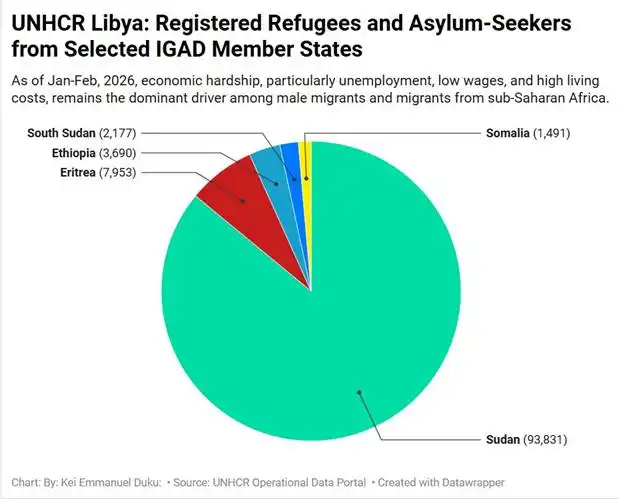
At the end of 2022, IGAD member states hosted 4.3 million refugees, about about one in every six refugees worldwide, with most orgnating from South Sudan, Sudan, Somalia and Eritrea
Recurrent conflict, prolonged political instability, drought and devastating floods continue to force millions from their homes, often triggering repeated displacement across borders.
The report identifies three major migration corridors used by people moving within and beyond the region. The Northern Route passes through Sudan, Chad, Egypt and Libya before crossing the Mediterranean toward Europe. The Eastern Route runs through Djibouti, northern Somalia and Yemen toward the Gulf States, while the Southern Route extends through Kenya, Tanzania, Zambia and Malawi toward South Africa.
Gathiang’s journey followed the Northern Route, one of the most dangerous migration corridors, where migrants depend heavily on smuggling networks and dangerous informal routes to move beyond the region.
The IGAD has repeatedly committed to improving regional mobility through frameworks such as Free Movement Protocol discussions, Regional Migration Policy Frameworks, and Labour Migration Governance initiatives.
On paper, the frameworks aim to facilitate the safe movement of workers within IGAD states, strengthen protection for migrant workers, and reduce reliance on irregular migration routes.
In practice, however, implementation remains uneven. These frameworks also don’t address movements outside the region.
As a result, many migrants rely on smuggling networks and irregular routes, often becoming stranded in transit countries such as Libya, where they face arbitrary detention, exploitation, human trafficking and extortion while waiting for an opportunity to continue toward Europe.
That unevenness is reflected in the migration patterns across the IGAD region. The International Organization for Migration (IOM) has documented a steady rise in the number of migrants travelling through the Eastern and Central Mediterranean routes from countries affected by prolonged conflict, economic decline, and climate shocks.
The price of escape
What began as an escape from floodwaters in Jonglei would soon become a journey across deserts, borders and one of the world’s deadliest seas.
Gathiang estimates he spent nearly every South Sudanese pound he had saved during three years of working as a boda boda rider in Juba, investing it all in a journey that would carry him thousands of kilometers across some of Africa’s most unforgiving terrain, from South Sudan through Sudan and Chad to Libya, before ending in the waters of the Mediterranean.
His journey started in Jonglei, then took him to Juba, and from there north through the town of Wau before he crossed into Sudan. From Sudan, he entered Chad, where he joined truck drivers transporting goods across the Sahara Desert into southern Libya.
Sometimes there were vehicles, and often there were none, he says. Migrants walked for hours across unforgiving desert under scorching temperatures, depending on truck drivers willing to exchange transport for labour.
Each stage of the journey, Gathiang says, is controlled by a different network of transporters, smugglers or armed groups, and at nearly every checkpoint, someone demanded payment.
Those who ran out of money often worked as laborers to earn a place on the next truck. Gathiang says others remained stranded for weeks or even months, taking whatever work they could find while trying to save enough to continue.
“Sometimes we walked long distances,” Gathiang remembered. “Sometimes we were arrested. Sometimes they [armed groups] took money before releasing us,” he added, without revealing the amount they were charged.
The farther north they travelled in Libya, the more uncertain life became, since border crossings did not depend on official documents so much as on whoever controlled the checkpoints.
“If the truck driver said you are working with him, sometimes they allowed you to pass,” Gathiang said. “But if you get someone that is heartless, they can put you in jail.”
Despite the ordeal, he still hopes to continue to Europe.
“Going back home, there is nothing I can do there,” he said. “If there is a way to reach Greece, I will continue.”
After the rescue, Gathiang says survivors were taken into detention, a routine fate for migrants intercepted along Libya’s coastline. It was only when authorities saw the extent of Gathiang’s burns that they released him, with instructions to ‘go and get medication at home.’
But there was nowhere to go. With no South Sudanese embassy nearby, no relatives in Libya, and no medical support available, Gathiang found himself relying on fellow migrants who had been there for a while and understood his ordeal, because many had lived through similar experiences.
Hussein Omar, another migrant who now acts as chairperson for the South Sudanese Community in Tobruk, said most of the migrants intend to reach Greece because it is nearer.
He said around 280 South Sudanese migrants in Tobruk have already registered with the community, all waiting to cross to Europe.
Displaced again and again
John (not his real name), a 34-year-old who asked that his identity be withheld for fear of reprisal, is another migrant currently in Libya. He was first displaced by the conflict in South Sudan in 2013 and fled to Sudan, then faced a second displacement when war forced him to flee Sudan after violence erupted there in 2023.
Like hundreds of thousands of others escaping the conflict, he travelled to Egypt, believing it would offer refuge until peace returned. Instead, he says, life gradually became another struggle in the host country.
“Egypt was good before,” he says. “But things changed. We [refugees] faced many problems. Even if you have documents, sometimes you are still arrested. The citizens fought us on the streets, especially us from South Sudan. I reached a point where I felt there was no future there.”
Unable to return to Sudan, and uncertain about returning to South Sudan, he made another impossible decision: he headed west toward Libya, recounting that for nearly eight hours, he and other migrants walked through stretches of desert with neither food nor water.
“People think the pictures they see from the Sahara are exaggerated, they are not,” John says. “That is exactly what happens. People die there. You walk without water. You don’t know whether you will reach the next stop.”
Even crossing the Libya-Egypt border proved equally dangerous. He says security patrols intercepted their group before they could reach their destination.
John, who was suffering from yellow fever, was arrested and detained. For the next ten days, a prison cell became his world, and before his release, the authorities demanded money.
John said migrants who could contact relatives were often expected to raise money before they could be released.
“Everything was about money,” he recalls. “If nobody paid for you, you remained inside.”
After he made contact with his family and friends in Juba, they sent about $1000. John was released. He estimates that securing his release required 1,500 Libyan dinars, about $200, but others could be less depending on the number of days a prisoner spent in prison.
For many migrants, though, that amount is impossible to raise, and some remain in detention for weeks while others spend months waiting for relatives to borrow money and send it.
John said among those locked inside was a young South Sudanese boy who had already spent more than a month in custody because no one could afford to pay for his release. When friends sent money to free John, he refused to leave alone.
“I told them I couldn’t walk away and leave the child behind,” he said. “If I was going out, he had to come with me.”
Instead of purchasing only his own freedom, he used part of the money to secure the release of other South Sudanese migrants. Eight of them walked out together.
“How could I leave them?” he asked quietly. “Tomorrow it could be me again.”
Many South Sudanese fleeing conflict in Sudan have found themselves displaced multiple times. Some escaped violence in Sudan only to face economic hardship and discrimination elsewhere, while others moved from refugee-hosting countries into Libya, hoping to find work or continue toward Europe.
“What brought me from Sudan to Egypt was war,” John says. “What brought me from Egypt to Libya was the treatment we faced there.”
“You hear every day that someone has died, disappeared or been arrested. It is difficult,” he adds.
For many migrants, displacement breaks families across multiple countries, scattering relatives between South Sudan, Sudan, Egypt, Libya, Tunisia and Europe. John’s own family is now shattered: his wife was deported to South Sudan, his two-year-old son remains in Egypt, and he has not seen his family in years.
“My son is safe, but we are separated,” he says.
Gov’t response
South Sudan’s Ministry of Foreign Affairs says it is aware of the growing challenges facing South Sudanese citizens stranded in Libya and other countries, where many have reported harassment, arbitrary arrest, detention and deportation.
Foreign Ministry spokesperson Thomas Kenneth Elisapana said the government has been engaging authorities in the affected countries through diplomatic channels to address the situation facing South Sudanese nationals.
“The Ministry has been engaging at the highest levels with the authorities of the concerned countries, both in Juba and in their respective capitals,” Elisapana said in a statement.
He adds that the government has established a multisectoral task force to coordinate the response, working to address cases of forced deportation and other concerns affecting South Sudanese nationals.
However, South Sudan does not have an embassy in Libya, limiting its ability to provide direct support to citizens detained or stranded there.
The ministry also did not outline any specific plans to expand consular assistance, leaving many migrants intercepted in Libya’s detention centres with little or no access to consular services.
Deadliest crossing
For many South Sudanese who reach Libya, the journey is not the beginning of their struggle but another stage in a life shaped by conflict, floods, and repeated displacement.
Every year, thousands gather along Libya’s Mediterranean coast, hoping to reach Europe. To governments, the sea marks an edge, but for smugglers, it is a business; for migrants, it is often the last gamble.
Disclaimer: The national boundaries and territories indicated on this illustrative map do not represent official, formal, or legally recognized frontiers. They are included solely as an imaginary geographic reference to illustrate the general directions of movement corridors in the region.
According to the International Organization for Migration’s Missing Migrants Project, the Central Mediterranean is the world’s deadliest known migration route. Since 2014, more than 32,000 people have died or disappeared attempting to cross to Europe, though the true number is believed to be much higher, since many shipwrecks go unrecorded.
An IOM Libya report published in early 2026 (Migrant Report Round 61) highlights the legal vulnerability of migrants in the country: 84% lacked residency permits, a gap even wider among women (90%) than men (83%), and 85% held no work permit. The report found that migrants from West, Central, and Eastern Africa were more likely to hold valid documentation than those from other regions.
Gathiang had no legal documents. For him, legal status offered little comfort. He was fully aware of the dangers when he stepped onto the overcrowded boat. Stories of shipwrecks and vanished migrants were constant refrains in Libya’s waiting grounds, yet after months spent without work, medical care, or hope, staying behind felt just as perilous.
He says policy debates about migration remain distant. His immediate hope is to recover from the burns he suffered during the Mediterranean crossing attempt, return to work, and one day support his family again.
Asked whether he regrets leaving South Sudan, he paused before answering.
“I only wanted to help my family.”
He now urges other young South Sudanese to think carefully before taking the same route.
“The Sahara is very dangerous,” he says quietly. “The sea is dangerous too. Before you leave, think carefully. The situation forced me to choose this road.”
Gathiang’s journey illustrates how climate change, unresolved conflict and shrinking regional protection systems are converging to reshape migration across East Africa. Experts say migration is no longer driven by a single crisis but by repeated displacement that leaves young people believing dangerous journeys offer their only remaining chance.
Behind him lies a flooded village in Jonglei. Ahead of him lies the Mediterranean, where thousands have disappeared under the same blue water that nearly claimed his life.
Between those two places stretches one of the world’s deadliest migration routes, a journey that, for growing numbers of South Sudan’s young people, begins long before they ever reach the sea.
Caption: The routes and geographic boundaries displayed on this map are illustrative and AI-generated. They may not precisely or accurately reflect established international boundaries. This map should not be used for navigational, administrative, or legal purposes.
Discover more from Access Radio Yei News
Subscribe to get the latest posts sent to your email.