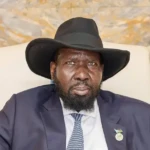
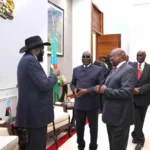


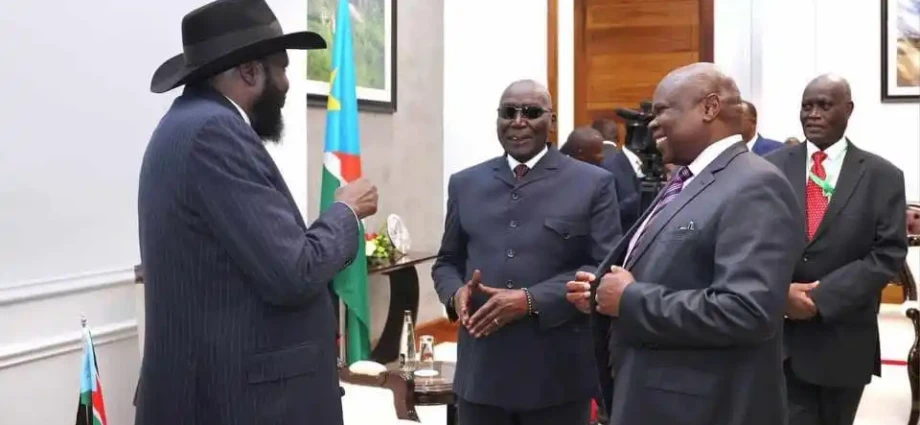
(JUBA, SOUTH SUDAN) – South Sudan’s planned December election has run into fresh difficulty after major opposition groups refused to take part in a national dialogue launched by President Salva Kiir.
The talks opened in Juba on 24th September 2026, two days after President Kiir dissolved the transitional government. The dialogue was meant to build agreement ahead of the general election on 22 December 2026.
But major opposition parties rejected the forum. The Sudan People’s Liberation Movement in Opposition (SPLM/A-IO), led by detained former First Vice President Riek Machar, and the Communist Party both said the process was controlled by the ruling party.
The boycott extends beyond Machar’s party. The United People’s Alliance and the National Democratic Movement also stayed away, according to the Spanish news agency EFE in September 2026.
The United People’s Alliance, led by Pagan Amum, said the dialogue lacked legitimacy and was designed to extend the rule of the incumbent administration. The alliance called for an inclusive national dialogue held at a neutral venue outside Juba.
Court Moves on Security Concerns
The Special Court hearing the case against Machar and seven co-accused has ordered tighter security measures. This followed concerns raised by Machar’s defence lawyer about threats to the accused and their legal team, as reported by the Kenyan legal news service Legalbrief in September 2026.
Presiding Judge James Alala Deng directed that court police personnel named in an investigation be removed from sessions with immediate effect. He also ordered security forces to ensure safe escort for the accused and defence teams.
The court dismissed a defence application about legal representation. Presiding Judge Stephen Simon Binjigwa said the panel had not interfered with the defendants’ right to choose their lawyers.
Prosecutors allege that forces aligned with Machar’s SPLM/A-IO and the White Army militia attacked a government military garrison in Nasir, Upper Nile State, in March 2025. They say 257 South Sudan People’s Defence Forces soldiers were killed.
The court has ruled that it has jurisdiction to prosecute Machar and the others. It dismissed objections from Machar’s legal team, who had argued that the proceedings were unconstitutional and that Machar enjoyed immunity from prosecution, as reported by the British Broadcasting Corporation in September 2026.
Kiir Warns Against Changing Timeline
President Kiir warned participants against using the talks to renegotiate or alter the election roadmap. He said the transitional arrangement must end.
“This inter-party dialogue is not a place for negotiations and disagreement,” President Kiir said at the opening session. “It is not a place to shift the direction of the path that we have taken. It is not a place to hold us back.”
The Office of the President of South Sudan reported in September 2026 that President Kiir described the dialogue as a significant milestone. He said the journey toward elections consists of four roadmaps: legal, administrative and logistical, security, and political dialogue.
The Dawn Newspaper, a South Sudanese publication, reported in September 2026 that President Kiir said the first track, the legal framework, has already been achieved. The administrative and security tracks are also progressing.
SPLM/A-IO interim deputy chairperson Regina Joseph Kaba said the party “categorically rejects” the dialogue. She said any electoral process without consensus and full participation “is rejected in its totality.”
Regional Bodies Urge Faster Preparations
The African Union Peace and Security Council, at its 1364th meeting on 26th August 2026, welcomed South Sudan’s commitment to hold credible elections on 22 December 2026. The Council also expressed deep concern over the political and security situation.
The Council said the transitional mandate must end in February 2027 without further extensions. It called on all parties to resume direct political dialogue without preconditions.
The Reconstituted Joint Monitoring and Evaluation Commission reported to the United Nations Security Council in August 2026 that implementation of the 2018 peace agreement had been “significantly constrained by the persistent political and security impasse that has endured since March 2025.”
RJMEC Interim Chairperson Ambassador George Owinow said preparations for the December elections were “way behind schedule.” He stressed that “critical prerequisites for the conduct of credible, peaceful and inclusive elections remain unmet.”
The Kenyan newspaper The Star reported in August 2026 that RJMEC had warned that political, legal, security and humanitarian conditions necessary for credible polls remain largely absent.
Electoral Preparations Face Hurdles
The National Elections Commission has begun training state elections committees on voter registration. NEC Chairperson Professor Abednego Akok Kacuol said inclusive voter registration is the right of every eligible citizen.
The Commission stated in September 2026 that voter registration has not yet started. It dismissed social media claims that registration was under way and that figures of registered voters had been released.
The Commission said the State High Elections Committees are almost done with assessing the voter registration centres to be used and have launched the civic and voter education campaign in nine states.
Both opposition parties have called on regional and international bodies, including RJMEC, IGAD, the African Union and the Troika, to note these unilateral measures and step in.
President Cyril Ramaphosa, chairperson of the African Union Committee on South Sudan, called on South Sudan’s leaders to address the opposition’s concerns. He said the Revitalized Agreement remains the only internationally recognised framework for the political transition.
Discover more from Access Radio®
Subscribe to get the latest posts sent to your email.