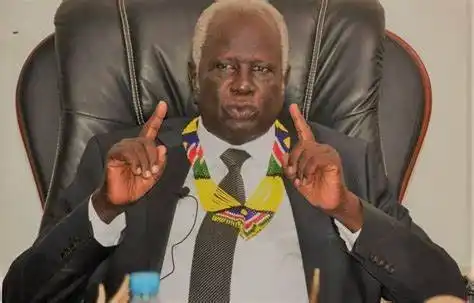
Prof-Abednego-Akok-Kacuol-Chairperson-National-Elections-Commission.Photo Credit: Morris Doga
(JUBA) – South Sudan’s National Elections Commission (NEC) has officially announced that the country’s general elections will be held on 22 December 2026, marking a significant step toward its first post-independence vote.
Speaking at the NEC headquarters in Juba on Monday, the Commission’s Chairperson, Professor Abednego Akok Kacuol, said the date complies with the National Elections Act 2012, as amended in 2023, which requires election dates to be announced at least six months in advance.
“The election will be conducted on 22 December 2026,” Kacuol told journalists. “From 22 June 2026 to 22 December 2026 is the six months as specified in the law.”
The announcement comes nearly two years after the Revitalized Transitional Government of National Unity (RTGoNU) extended the transitional period for a fourth time in September 2024, pushing the country’s long-delayed elections from December 2024 to December 2026.
Since gaining independence in 2011, South Sudan has yet to hold a national election, making the upcoming vote a historic opportunity for citizens to elect their leaders.
However, the NEC cautioned that several critical challenges must be addressed before the polls can be successfully conducted. Kacuol highlighted legal gaps, funding shortages, and security concerns as major obstacles.
“There are legal contradictions which should be amended. The law must be amended,” he said. “The second challenge is the availability of resources so that we continue with the election processes.”
According to the NEC, approximately 250 million US dollars are required to carry out the elections, but only a fraction of the funds has been secured so far. The commission has repeatedly appealed to the government to accelerate funding and legal reforms.
“We strongly request the government to speed up amending the existing legal gaps and provide all the basic needs within a short period to enable us to proceed with our duties and responsibilities,” Kacuol added.
Following the announcement, the NEC said it would begin developing a detailed electoral calendar, including voter registration. The commission expects to release a realistic timeline before the end of June.
“After this declaration, we are now to embark on a realistic electoral timeline. When we make it, we shall let you know,” Kacuol said.
He noted that, based on past experience, voter registration could take about one month once the process begins.
The commission also plans to distribute operational funds to election offices across the states as part of preparations.
Despite these steps, concerns remain over the feasibility of conducting elections in areas affected by insecurity and intercommunal violence, as well as the participation of displaced South Sudanese living in neighbouring countries.
Kacuol acknowledged the concerns, noting that ensuring security lies primarily with the government.
“The political will belongs to the government. Availability of resources is to be provided by the government,” he said. “The government knows better than us regarding insecurity.”
He added that an election security body established last year has already begun preparations and training to support the electoral process.
The NEC Chairperson urged citizens to prepare to participate, emphasising that voting is central to democratic governance.
“The public is to be informed that their sovereignty is to vote during the election as the only way of getting into power,” he said.
The announcement sets the stage for what could become one of the most consequential political events in South Sudan’s history, although significant legal, financial, and security challenges remain in the months ahead.
Discover more from Access Radio Yei News
Subscribe to get the latest posts sent to your email.