




JUBA—The South Sudan Opposition Alliance (SSOA) has defended Political Parties Council (PPC) Chairperson James Akol Zakayo against allegations by opposition leaders Dr. Lam Akol and Moro Isaac Genesio that he abused his powers by altering party leadership records and registering seven political parties after the June 30 deadline.
The alliance said Monday that the seven parties were not newly added to the register after the deadline, but were political movements that had started the registration process earlier and only completed outstanding requirements after relinquishing their military wings.
On September 30, Lam Akol, leader of the faction of National Democratic Movement (NDM), and Moro Isaac Genesio of the South Sudan National Movement for Change (SSNMC), together with other opposition figures, accused the PPC chairperson of unilaterally changing the names of party leaders and adding seven parties to the register. They also questioned the authority of the PPC chairperson to alter the official registration records.
The dispute followed circulation of a new list of registered political parties and the issuance of PPC Order No. 5 of 2026, which granted full registration and civilian political status to a number of political entities.
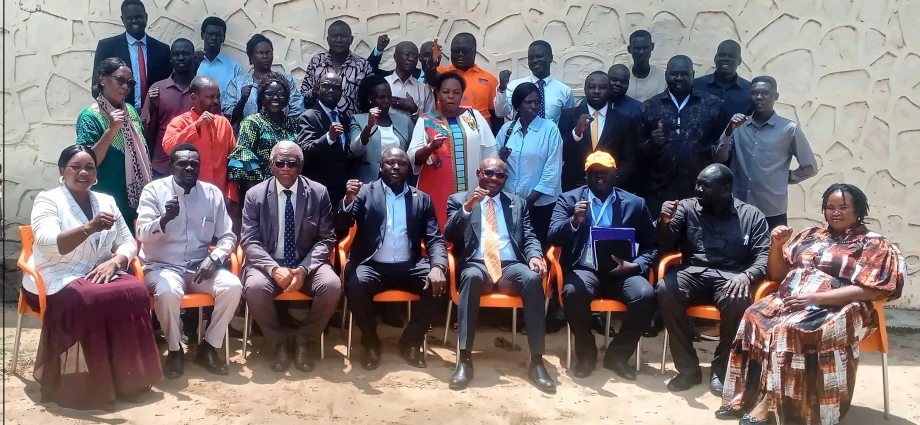
At a media briefing in Juba on Monday, SSOA Secretary General Changkuoth Bichiok Reth said the accusations against Akol were unfounded and that the seven parties had substantially completed their registration processes before the June 30 deadline.
“The seven political parties alluded to are legitimate constituent members of SSOA,” Bichiok said.
He said the registration of the parties had been delayed because their leaders were still associated with military structures, which had to be resolved before they could operate exclusively as civilian political organisations.
Under the Political Parties Act, a political party must not use military or paramilitary formations to achieve its political objectives. The 2022 amendments specifically prohibit political parties from establishing covert or overt military formations, armed forces or paramilitary forces.
Bichiok said the seven party leaders publicly relinquished their military command in December 2025 and surrendered their forces to the country’s central military command.
He said the move cleared the way for the parties to complete their registration with the PPC.
The seven parties named by SSOA are the South Sudan Patriotic Movement, South Sudan National Movement for Change, Federal Democratic Party, National Salvation Front, National Democratic Movement, South Sudan United Movement and South Sudan Liberation Movement.
Bichiok said the parties had obtained clearance confirming that their forces had been surrendered and were being integrated into the regular security structures.
He rejected claims that the PPC had arbitrarily added the parties to the register after the deadline.
“The PPC did not simply add seven parties to the registered political parties list, It completed the registration of political party organisations whose registration had been delayed by specific legal and political impediments that had subsequently been removed,” he said.
SSOA also accused Lam Akol and Moro of failing to meet the same requirement because, according to the alliance, their factions had not relinquished their military structures.
Bichiok said their failure to complete registration was therefore a consequence of non-compliance with the law rather than an abuse of authority by the PPC chairperson.
The PPC is mandated under Section 21 of the Political Parties Act to register, regulate, monitor and deregister political parties.
The alliance further defended the PPC’s handling of disputed party leadership records, including the Federal Democratic Party, after opposition leaders alleged that the council had replaced recognised party leaders with other individuals.
The accusations had included claims that the PPC altered the names and leadership of the NDM, SSNMC and FDP and that the changes could affect the parties’ participation in the December 22 elections.
Bichiok said SSOA also rejected claims that the individuals listed by the PPC were “unknown” figures, saying the leaders of the seven parties had been involved in the opposition movement and the peace process.
He challenged Lam Akol and Moro to provide evidence that the PPC violated the Political Parties Act.
“Let them show you where are their forces and whom did they give their forces to,” Bichiok said.
The alliance said it supports equal participation of political parties in the electoral process but maintained that parties must first meet the legal requirements for registration.
SSOA also said it remained open to dialogue with Lam Akol and other political actors to resolve the dispute.
“Our doors are open for engagement,” Bichiok said. “Political disagreement, we should sit down and see where are the disagreements, how can we move forward.”
The PPC had not publicly responded to the accusations when the allegations were first reported.
The dispute comes as South Sudan prepares for the scheduled December 22 elections, with political parties facing increased pressure to resolve registration and leadership disputes before the polls.
Discover more from Access Radio®
Subscribe to get the latest posts sent to your email.