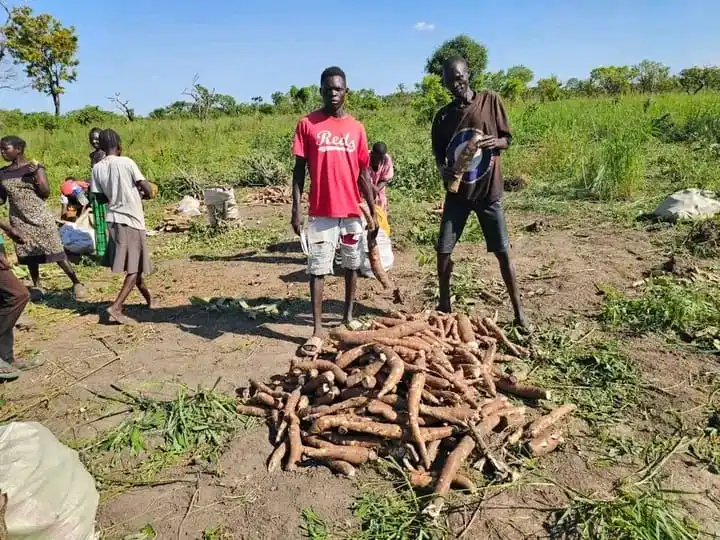
PHOTO CREDIT: Morling Cooperative Society
(KAJO-KEJI COUNTY) – Morling Cooperative Society in Kajo-Keji County, Central Equatoria State, has launched a large scale mechanised farming programme aimed at tackling food insecurity and supporting wealth creation through crop farming.
The cooperative’s Chief Executive Officer, Alex Anyik Joseph, said the initiative was prompted by South Sudan’s heavy reliance on food imports from neighbouring countries, which continues to expose the country to shortages and high prices.
According to Anyik, the cooperative has already ploughed 10 feddans of farmland in Beket of Lire Payam and Sera-Leyikor in Kangapo One Payam, where they are preparing to plant white sorghum, dura, maize and beans for the second crop planting season.
“Our cooperative society implements smart agriculture programmes. We focus on climate resilient crops such as sorghum, maize and beans using modern agronomic practices. Our aim is to produce enough food for the country while selling any surplus in the market,” Anyik said.
He explained that part of the second cereal crop production will also focus on seed multiplication. The seeds will be distributed to local farmers and returnees in order to encourage self reliance and wealth creation in the coming year.
Anyik said the cooperative plans to expand its farming from 10 to 100 feddans across all five payams of Kajo-Keji County. He urged the government to provide security, farming tools, storage facilities and better roads to support grassroots farmers.
“Our call to the government is that large scale farming should take root at county level. We need stable security, good roads and storage so that farmers can focus on food production, which is key to addressing food scarcity and improving the economy.”
Sanyu Moses Mure, a technical advisor to the cooperative, acknowledged that Kajo-Keji’s fertile soils are suitable for farming but said several challenges persist. These include limited access to farm implements, poor seed varieties, inadequate storage, lack of large markets and weak capacity building:
“To improve farming in the green belt areas, there is urgent need for better seeds, machinery for planting and packaging, and training for cooperative farmers. These are the key challenges that must be addressed.”
He appealed to the government and development partners to prioritise mechanised farming by supporting cooperative societies and progressive farmers to address national food insecurity.
The Acting Director of Agriculture in Kajo-Keji County, Alex Khamis, also encouraged farmers to embrace modern farming techniques and integrated systems:
“Farming is the best way forward. I call on all farmers, whether individuals or cooperatives, to use integrated approaches by combining food production with livestock keeping to increase both food and income.”
He acknowledged that government support is limited, but urged farmers to continue working with what they have:
“Even if support is delayed, farmers can use local tools such as hoes, granaries and bicycles to keep producing food and transporting it to nearby markets. Let us not wait for external help to start farming.”
Khamis called on the national and state governments, as well as non governmental organisations, to provide farm tools, quality seeds and improved market access to strengthen the contribution of local farmers in fighting poverty and hunger.
Cooperative Farming Plan in Kajo-Keji
| Item | Current Level (2025) | Target Level (Next Year) |
|---|---|---|
| Land cultivated | 10 feddans | 100 feddans |
| Crops planted | Sorghum, maize, beans | Sorghum, maize, beans |
| Seeds distributed | Small scale | For local farmers & returnees |
| Payams covered | 2 | 5 |
| Expected outcome | Household food supply | Surplus for markets |
Discover more from Access Radio Yei News
Subscribe to get the latest posts sent to your email.