immunization-week-1
(OPINION / DR. KOITI EMMILY) – As World Immunization Week draws to a close, South Sudan finds itself at a crossroads that is as it is public health driven. This is not a moment for quiet reflection it is a moment that exposes the gap between what is discussed in policy rooms and what is delivered in clinics.
In recent weeks, government officials development partners, and national stakeholders have gathered to assess progress under Gavi, the Vaccine Alliance 5.0 and to chart the path forward. That process has culminated in a high-level, in-country grant consolidation dialogue now underway. These are not ceremonial meetings. They are decision points that will shape how vaccines are financed and sustained in the years ahead.
Yet even as these conversations unfold, some public health facilities are running without the Bacillus Calmette–Guérin (BCG) vaccine. That contradiction should not be dismissed as a routine supply hiccup. It is a warning sign—one that points directly to weaknesses in how health priorities are financed.
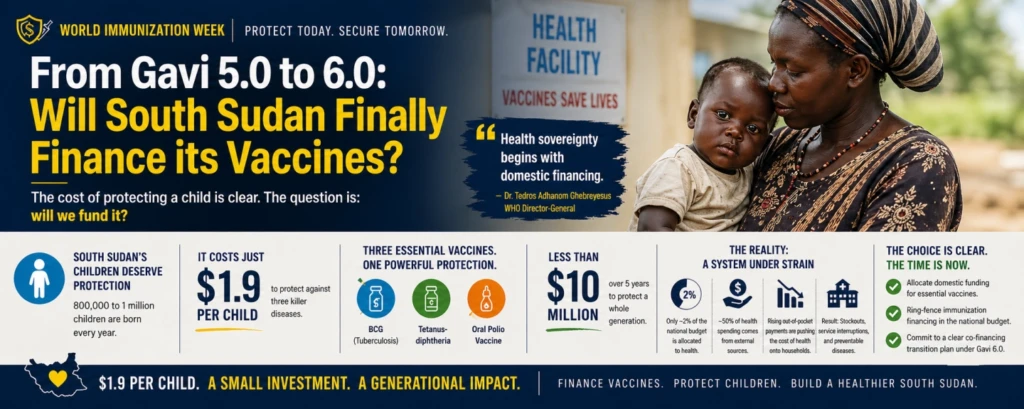
The economics leave little room for ambiguity. For roughly $1.9 per child, South Sudan can secure a package of essential vaccines, including BCG, tetanus-diphtheria, and oral polio. Fully vaccinating the country’s children each year costs under $10 million. In the context of national budgeting, this is not an overwhelming figure. When vaccines at this price are unavailable, the issue is not affordability it is prioritisation.
For years, South Sudan’s immunisation programme has leaned heavily on external support, particularly from Gavi and other partners. That model has saved lives, but it was never meant to be permanent. Now, as external funding begins to plateau, the absence of a meaningful increase in domestic financing is becoming harder to ignore.
The government’s own 2024–2025 Annual Health Sector Performance Report paints a stark picture. Public health expenditure hovers at around 2% of the national budget far below the 15% target set under the Abuja Declaration. Meanwhile, nearly half of all health spending comes from external sources. As that support stabilizes or declines, the burden is quietly shifting to households through out-of-pocket payments.
This is how financing gaps become service gaps. Vaccines arguably the most cost-effective intervention in public health become vulnerable when the system that funds them is fragile. The absence of BCG in a facility is not just a stockout; it is a symptom of structural underinvestment.
The consequences are immediate and severe. Without BCG, newborns face heightened risk of serious forms of tuberculosis, including meningitis and disseminated disease conditions that are often fatal or leave lasting damage. These are preventable outcomes, and their persistence reflects choices made far from the bedside.
What makes this situation more frustrating is that the policy groundwork already exists. South Sudan has established a Health Financing Unit, developed coordination mechanisms, and initiated engagement with legislative processes. The problem is not a lack of ideas. It is a lack of execution.
Budget allocations remain stagnant. Proposed reforms ranging from innovative financing mechanisms to a national health insurance framework are still largely on paper. This is no longer a policy gap; it is an implementation failure.
The transition from Gavi 5.0 to 6.0 presents a critical inflection point. The current dialogue is not just about reviewing past performance; it is about redefining responsibility. Will South Sudan begin to take on a greater share of financing its immunisation programme, or will it continue to depend on external lifelines?
This question echoes a broader principle articulated by Tedros Adhanom Ghebreyesus: health sovereignty is ultimately grounded in domestic investment. Not rhetoric, not strategy documents but actual budgetary commitment.
None of this diminishes the essential role of development partners. Their contributions remain indispensable. But external support works best when it complements national investment, not when it substitutes for it. Sustainability, predictability, and ownership all depend on domestic financing taking the lead.
At its core, the issue is disarmingly simple. If a country cannot reliably allocate $1.9 per child for life-saving vaccines, the constraint is not purely financial it is strategic.
As World Immunization Week ends and policymakers deliberate on the future of immunisation in South Sudan, the path forward is clear. The time for dialogue has passed its peak. What remains is the harder task: making decisions that translate into budget lines, procurement orders, and vaccines in clinics.
Because in the end, a nation’s priorities are not declared in meetings they are revealed in its budget.
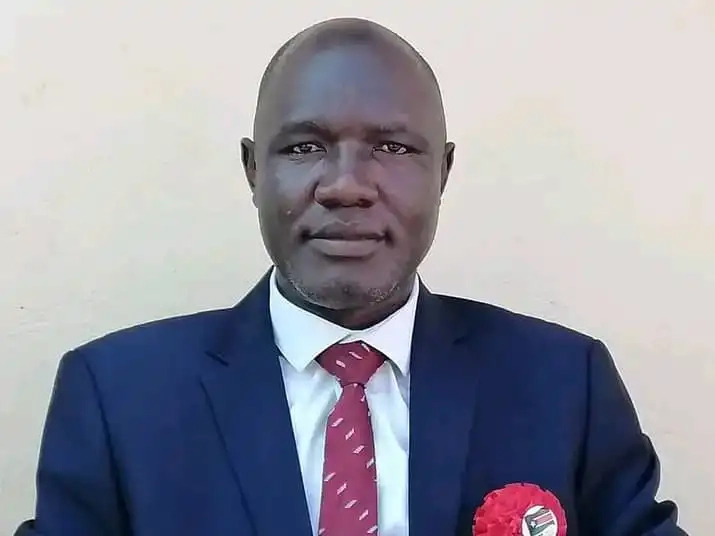
Author: Koiti Emmily
A medical doctor who writes about health, governance and human rights issues.
DISCLAIMER:
Access Radio publishes opinion articles to provide a platform for diverse and independent views within our community. The opinions expressed in these articles are solely those of the authors and do not necessarily reflect the views of Access Radio® or its editorial team.
The publication of an opinion piece does not imply agreement with or endorsement of the ideas or perspectives presented by the author.
Responsibility for the accuracy of facts and opinions rests entirely with the contributor. Access Radio® does not assume responsibility for verifying the claims made in opinion submissions.
We welcome thoughtful opinion contributions from our listeners and readers. To share your views, please email news@radioyei.org. All submissions may be edited for grammar, clarity, or style before publication.
Discover more from Access Radio Yei News
Subscribe to get the latest posts sent to your email.