
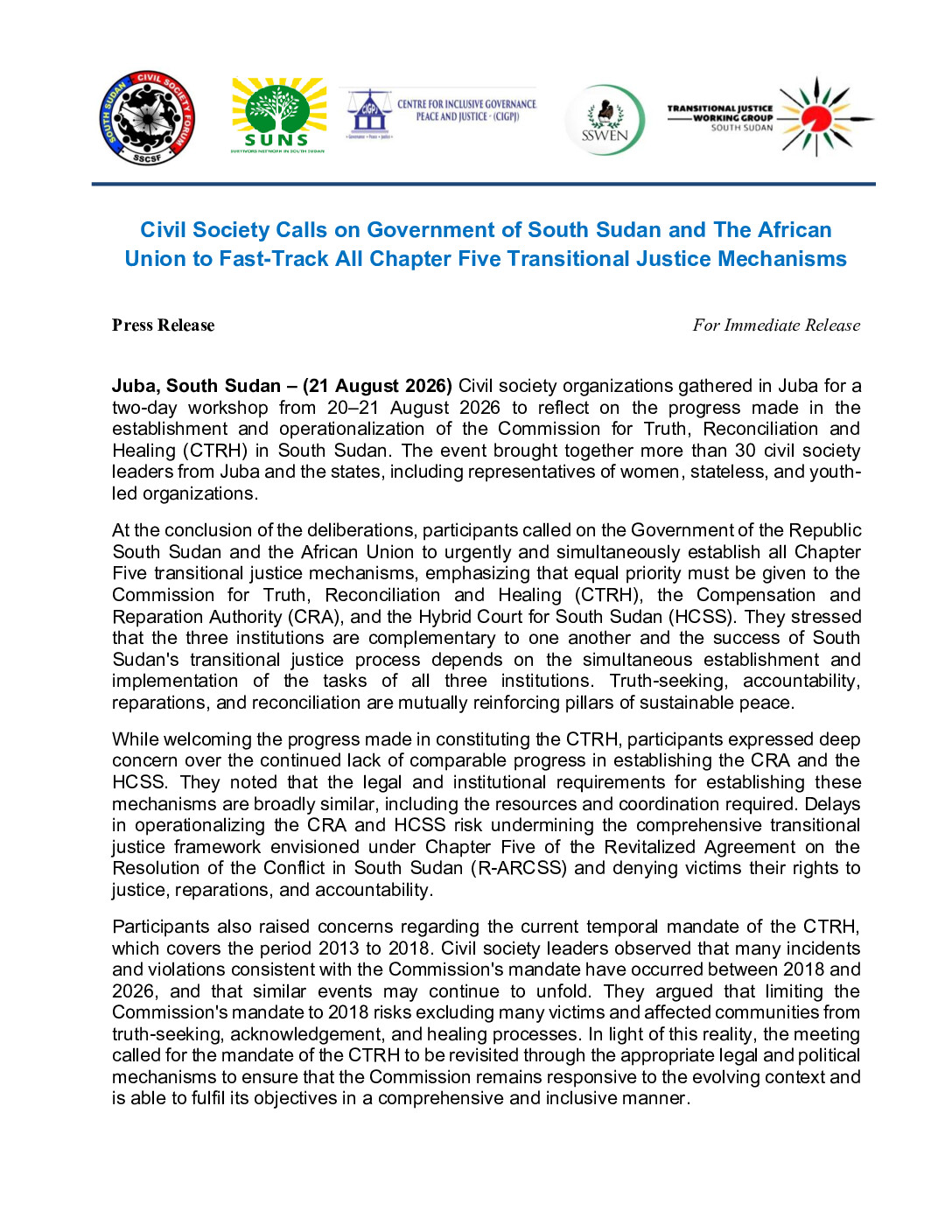
(JUBA) – South Sudanese civil society organisations have called on the Government of South Sudan and the African Union (AU) to urgently fast-track the establishment of all Chapter Five transitional justice institutions, warning that delays could undermine justice, accountability, and lasting peace in the country.
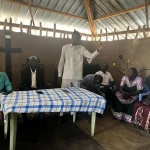
The appeal was made at the conclusion of a two-day workshop held in Juba from 20 to 21 August 2026, where more than 30 civil society leaders, including representatives of women, youth, and stateless groups, reviewed progress in establishing the Commission for Truth, Reconciliation and Healing (CTRH).
Participants welcomed progress made in constituting the CTRH but stressed that equal priority must also be given to establishing the Compensation and Reparation Authority (CRA) and the Hybrid Court for South Sudan (HCSS). They argued that truth-seeking, accountability, reparations, and reconciliation are interconnected pillars that must be implemented simultaneously to ensure a credible transitional justice process.
Civil society leaders expressed concern over the lack of comparable progress in operationalising the CRA and HCSS, noting that prolonged delays risk denying victims access to justice, reparations, and accountability as envisioned under Chapter Five of the Revitalised Agreement on the Resolution of the Conflict in South Sudan (R-ARCSS).
The meeting also raised concerns about the current mandate of the CTRH, which covers the period between 2013 and 2018. Participants observed that many violations and incidents falling within the Commission’s objectives have occurred since 2018 and could continue in the future. They called for a review of the Commission’s mandate to ensure that victims affected after 2018 are not excluded from truth-seeking, acknowledgement, and healing processes.
Civil society groups acknowledged recent milestones toward establishing the CTRH, including the completion of the vetting process for South Sudanese commissioner nominees and the African Union’s submission of non-South Sudanese commissioner nominees to the government. They described these developments as important steps towards fully constituting the Commission.
The participants further urged the Government and the African Union to provide adequate financial and institutional support to all Chapter Five institutions, safeguard them from political interference, and ensure meaningful engagement with victims, civil society organisations, women, youth, traditional leaders, and faith-based groups.
The workshop concluded with a renewed commitment by civil society organisations to work with national, regional, and international partners in supporting the full implementation of Chapter Five of the R-ARCSS and advancing a victim-centred transitional justice process aimed at delivering truth, accountability, reparations, reconciliation, and sustainable peace in South Sudan.
The meeting was convened by the Transitional Justice Working Group (TJWG) and the South Sudan Civil Society Forum (SSCSF) in partnership with the Center for Inclusive Governance, Peace and Justice (CIGPJ), Survivors Network in South Sudan (SUNS), and the South Sudan Women Empowerment Network (SSWEN)
Discover more from Access Radio®
Subscribe to get the latest posts sent to your email.