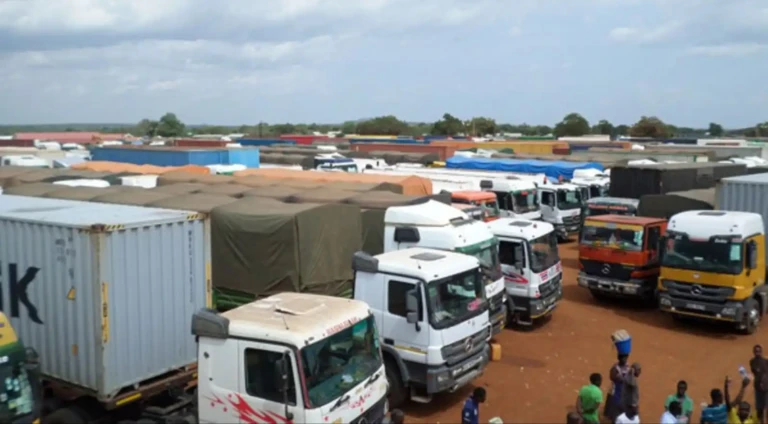
South Sudan, Kenya Move to Fix Trade Imbalance / FILE PHOTO
(NAIROBI, KENYA) – South Sudan’s Ambassador to Kenya is urging the Kenyan government to address major trade barriers, calling the high cost of a customs bond a serious obstacle for traders.
During a meeting with Regina Ombam, the Principal Secretary at Kenya’s Ministry of Investments, Trade and Industry, Ambassador Anthony Louis Kon raised several key challenges affecting trade between the two countries.
Ambassador Kon was particularly concerned about a fee that traders must pay to guarantee goods passing through Kenya reach South Sudan. He said the cost is “just too high” and is one of the biggest challenges facing South Sudanese businesses.
“We talked about the trade imbalance,” Kon said, noting that while Kenya exports a lot of goods to South Sudan, little goes the other way. “I believe this needs to change. We must support our South Sudanese businesses to grow, produce and access the market, including right here in Kenya.”
The ambassador also raised concerns about long delays, high charges and complicated paperwork, all of which are serious issues for South Sudanese businesspeople operating in Kenya. He proposed a formal Memorandum of Understanding to help both countries better coordinate business forums and trade fairs.
Ambassador Kon stressed the vital role Kenya plays as a trade partner, stating that the Port of Mombasa and the Northern Corridor are “not just transporting roads. They are lifelines for our economy and our people.” He has asked the principal secretary to help find “real solutions to make things easier for our people.”
The Northern Corridor stretches approximately 1,700 kilometres from the Port of Mombasa through Uganda, Rwanda, Burundi and eastern Democratic Republic of Congo, serving as the primary trade route for South Sudan’s imports and exports. South Sudan is the second largest user of the Port of Mombasa after Uganda, with about 80% of the country’s imports passing through the Kenyan facility .
According to Africa Press, Kenya currently charges $5,000 (KES 646,250 / SSP 32.5 million) per container destined for South Sudan, a fee South Sudanese officials have described as unjustifiable. South Sudan’s Transport Minister Rizik Zakaria Hassan said goods heading to Kenya face a $1,000 fee, while those destined for Uganda and the Democratic Republic of Congo are charged $1,500, making the South Sudan rate more than triple that of other regional markets.
The South Sudan Chamber of Commerce chair Ladu Lukak warned that the combined cost of shipping, security and handling now exceeds the value of the goods themselves in many cases.
Bilateral trade between Kenya and South Sudan declined from $246 million to $168 million in a single year, according to figures presented at Nairobi trade talks.
Data from the Observatory of Economic Complexity shows Kenya exported $220 million to South Sudan in 2024, while South Sudan’s exports to Kenya stood at just $97,200, highlighting a near total trade imbalance.
The two countries have taken steps to address the bottlenecks. The EastAfrican reported that Kenya and South Sudan agreed to tackle 29 non-tariff barriers and accelerate work on the Nadapal-Juba corridor, with the remaining 11-kilometre Nadapal-Nakodok stretch expected to cut delivery times from 14 days to seven .
According to Government Advertising Agency, Kenya has activated the Naivasha Inland Container Depot as a strategic hub for transit cargo bound for neighbouring countries. South Sudan has been allocated 10 acres within the Naivasha Special Economic Zone to establish a cargo clearance facility, with operations expected to begin within five months .
South Sudan Revenue Authority Commissioner General William Kuol said the Naivasha ICD offers a faster and more predictable clearance process that will significantly improve cargo movement to South Sudan .
South Sudan has also moved to diversify its trade routes. The Tanzania Revenue Authority reported that South Sudan requested customs cooperation in January 2026 to use the ports of Tanga and Dar es Salaam as alternative entry points for its cargo . The distance from Dar es Salaam to Juba is about 1,948 kilometres, compared with approximately 1,600 kilometres between Mombasa and Juba.
The challenges along the corridor extend beyond costs. The Star reported that Kenyan truck drivers have faced attacks, extortion and harassment on the Juba-Nimule Highway, with more than 60 cases reported this year alone. Foreign truck drivers lose an average of about $500 (KES 64,650 / SSP 3.25 million) in illegal payments while travelling the 125-kilometre stretch between Aru Junction and Nesitu .
Private sector efforts are also underway. According to The Star, Viaservice Kenya and Capital Pay International signed a partnership in March 2026 to digitise container tracking and replace the $5,000 cash deposit requirement with a technology-driven guarantee system.
Viatrans global head of trade facilitation Morgan Lepinoy said the initiative aims to remove structural barriers that slow trade along the South Sudan corridor .
Discover more from Access Radio Yei News
Subscribe to get the latest posts sent to your email.