Classified Evidence Row Dominates Kenya Drug Trafficking Trial / PHOTO: Directorate of Criminal Investigations - DCI
(MOMBASA) – A major drug trafficking trial in Kenya has exposed tensions between military secrecy and the rights of accused persons.
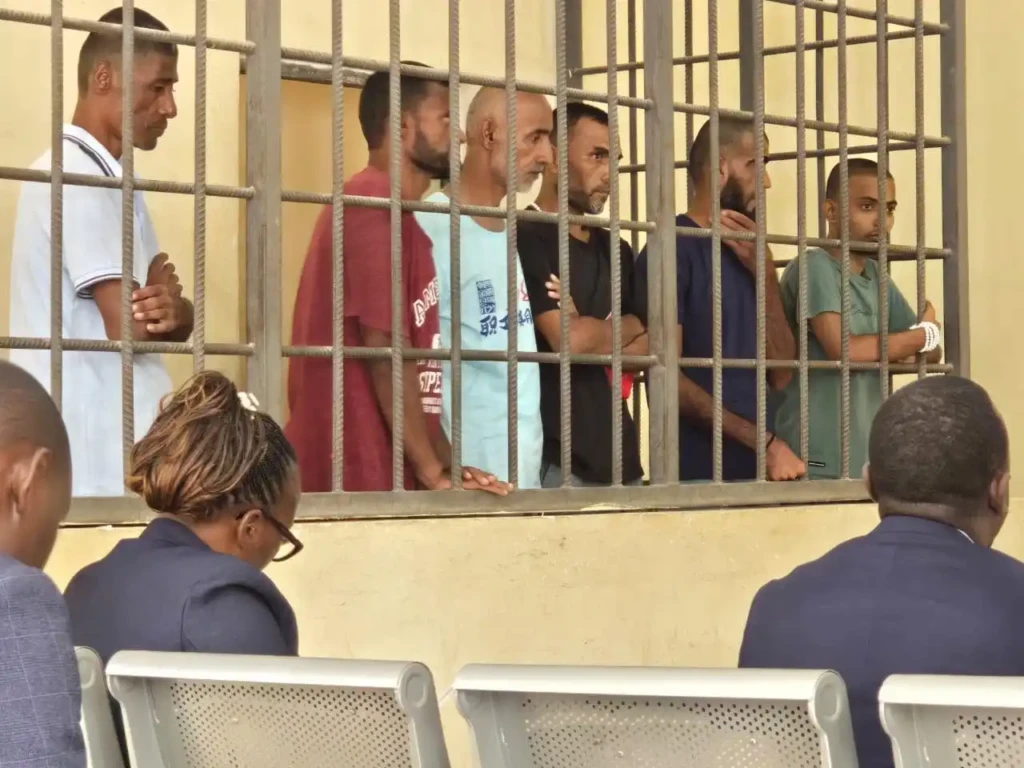
The prosecution closed its case last week in the trial of six Iranian nationals accused of trafficking methamphetamine valued at 8.2 billion Kenyan shillings, or about 63.1 million US dollars (410 billion South Sudanese pounds). The case arose from the interception of a vessel named MV Mashaallah in the Indian Ocean in October last year.
Throughout six months of hearings, the Kenya Navy repeatedly declined to share certain operational details and photographs taken during the high seas interception. Military witnesses said the information was classified and could not be disclosed because it related to sensitive operational procedures.
The defence argued that in any criminal trial, the law requires the prosecution to disclose all material evidence so its authenticity and reliability can be tested.
The defence said the withheld information was necessary to establish the truth and eliminate any possibility that the narcotics could have been planted inside the vessel before it reached the Port of Mombasa.
The classified material largely concerned how the vessel was intercepted at sea, the deployment of military assets and certain records generated during the operation. The most contested issue involved photographs allegedly taken immediately after the drugs were recovered on the high seas.
The Kenya Navy produced an inventory detailing items recovered from the vessel. Photographs allegedly taken inside the vessel before the cargo was disturbed were not produced in court. When pressed by the defence, military witnesses stated the images were classified.
The defence then questioned how the court could independently verify that the narcotics produced as exhibits were recovered from inside the vessel in the exact manner described by prosecution witnesses.
According to the defence, photographs taken before the cargo was disturbed would have provided visual confirmation of how the drugs were arranged or concealed.
The military witnesses maintained that the inventory accurately documented everything recovered from the vessel at all stages of the interception and recovery.
Major Mohamed Abdirahman, who commanded KNS Shupavu during the operation, said the inventory was prepared in English and detailed everything recovered from the vessel.
He said the Navy was not hiding anything and that the photographs taken at sea were classified. He added that classified communication directing that the vessel be towed to Mombasa had also not been disclosed.
He further explained that classified information exists in different categories, with “secret” being one of them. He said some materials produced are classified and the military has the discretion to release certain documents even if they are classified. He added that the classified documentation in question would not benefit the court.
Major Abdirahman said the soldiers did not take photos of the cargo on the vessel but only took photos for purposes of briefing their superiors. He said the items in the photos presented in court were similar to those taken at the high sea, but the ones taken by the Navy were classified. He maintained that the photos in court were not taken at the high seas.
He added that all relevant documentation had been supplied except for the classified photographs. He said it was not correct that the evidence to place the substance aboard MV Igor was classified, as the inventory showed everything found on the vessel.
Major Abdirahman firmly rejected suggestions that the narcotics could have been planted. He said the claim that the accused were on a fishing expedition was not correct and that there was no documentation at sea to confirm the consignment. He said an inventory was taken at sea and filled on October 20 before docking at the port of Mombasa.
The court heard that the operation was carried out by the Kenya Navy patrol vessel KNS Shupavu after authorities acted on intelligence reports that prompted planning and deployment on the high seas.
Even the specification of the warship that carried out the operation was not disclosed to the court. Lt. Col Job Gitonga said it was classified information on the number of military officers on board or the number of small boats.
Major Abdirahman told the court that he could not state how many personnel boarded the vessel because that was classified, though he later said 16 officers boarded MV Igor on a rotational basis. He said they reported immediately contact was made with MV Igor and that the report is a classified document. The code name for the operation was MV Igor.
The prosecution relied on the inventory, witness testimony and other documentary exhibits to maintain that the chain of custody remained intact and that the narcotics produced before the court are the same drugs recovered during the naval operation.
The defence also questioned the handling of certain material samples, arguing that although they were collected from the vessel they were never returned.
Major Abdirahman said the sample brought to KNS Shupavu was not returned to the vessel and that after they saw what the sample looked like they briefed headquarters after taking photographs uploaded under a tactical chat. He said he did not have any document to support the chain of custody of the sample.
With the prosecution case now closed, both parties are expected to file submissions reinforcing their respective positions. The prosecution called 12 witnesses who produced numerous exhibits and documentary evidence.
The final prosecution witness was the lead investigating officer, Inspector Shadrack Kemei, who outlined the chain of investigations. He told the court that the Anti Narcotics Unit received intelligence on October 19, 2025, indicating that the Kenya Navy had launched an operation to intercept a suspicious vessel suspected of transporting narcotic drugs.
On October 20, 2025, the Kenya Navy confirmed that it had intercepted the vessel, which had been identified as a dark vessel because it was operating without an Automatic Identification System, before escorting it into Kenyan waters.
Inspector Kemei testified that detectives obtained search warrants from the Mombasa Law Courts on October 24, 2025, authorising them to board, search, seize and detain the vessel Mashaallah. Accompanied by officers from the Kenya Navy and the Kenya Coast Guard Service, detectives boarded the vessel and served the warrant on its captain, Jaseem Darzadeh Nia.
An initial search yielded two packets containing a white crystalline substance that was subjected to a field test. Inspector Kemei said the field analysis confirmed the substance to be methamphetamine with an estimated purity of approximately 98 percent, necessitating a comprehensive search after the vessel docked at the Kenya Navy Mtongwe Jetty.
The subsequent search uncovered 769 packets of methamphetamine concealed in six of the vessel’s seven compartments. The narcotics and the vessel were seized, leading to the arrest of the six crew members: Jaseem Darzadeh Nia, Nadeem Jadgal, Hassan Baloch, Raheem Baksh, Imran Baloch and Imtiyaz Daryay.
Inspector Kemei further testified that investigators recovered five mobile phones and four SIM cards from the suspects, which were subjected to forensic examination at the Anti Terrorism Police Unit Cyber Forensics Laboratory.
A government supervised weighing exercise established that the seized narcotics weighed 1,036.044 kilogrammes with an estimated street value of 8.2 billion shillings, about 63.1 million dollars or 410 billion SSP.
The prosecution alleges that the offence was committed between October 17 and 20, 2025, on the high seas at Latitude 04°46.79’S and Longitude 045°27.42’E, about 350 nautical miles east of the Port of Mombasa.
Inspector Kemei told the court that the accused persons informed investigators that the consignment had been loaded at Pozm Port in Iran and was destined for Mauritius.
He further testified that the Kenya Maritime Authority established that the vessel had no registration documents and was therefore stateless, while analysis by the Government Chemist confirmed the recovered substance was methamphetamine.
The court has directed both the prosecution and the defence to file written submissions within 14 days. The matter will be mentioned on July 13.
Discover more from Access Radio Yei News
Subscribe to get the latest posts sent to your email.