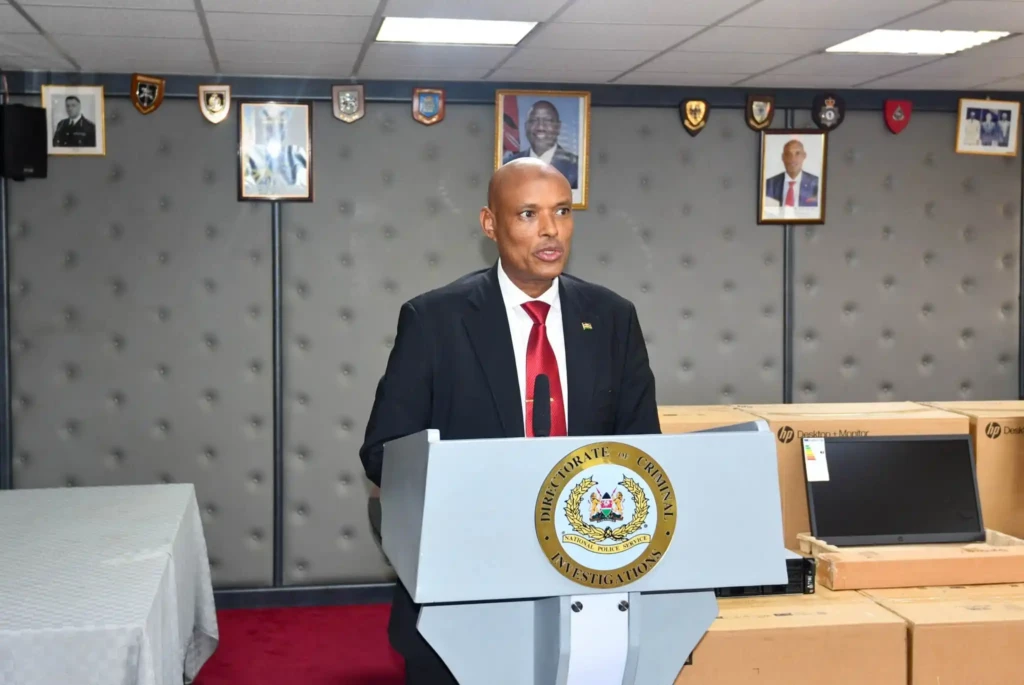
Director (DCI) Mr. Mohamed I. Amin / PHOTO CREDITS: Directorate of Criminal Investigations - DCI, Kenya
(NAIROBI) – A government payroll audit in Kenya has uncovered suspected irregularities worth 6.2 billion Kenyan shillings, or about 47.7 million US dollars (310 billion South Sudanese pounds), prompting a major criminal investigation and sweeping reforms.
A sample audit of just 12 out of 53 state departments revealed unauthorised changes to payroll records, irregular salary payments, weak controls over statutory deductions and fragmented payroll management systems.
The findings carry clear lessons for South Sudan, where public sector payroll management has long faced similar challenges of ghost workers and weak oversight.
The Cabinet, chaired by President William Ruto, directed the Directorate of Criminal Investigations to investigate payroll fraud, verify personal numbers used in payroll processing, dismantle criminal networks manipulating government payroll systems, recover lost public funds, and ensure the immediate arrest and prosecution of all persons found responsible.
The Cabinet also approved far reaching reforms aimed at cleaning up the public payroll and restoring integrity to the management of the government wage bill.
These measures include a government wide audit of all remaining state departments and public institutions. All ministries, departments, agencies and state corporations will be required to migrate to the revamped Integrated Human Resource and Payroll System.
Further directives included the enhancement of cybersecurity measures, the cleansing and validation of payroll data, the establishment of a disaster recovery site, and the integration of payroll systems with other public financial management platforms.
Beyond the payroll crackdown, the Cabinet also decided to freeze the leasing or hiring of additional government office space pending an audit of office use, as part of efforts to cut public expenditure.
The Cabinet established a Standing Cabinet Committee on Artificial Intelligence to coordinate Kenya’s national AI strategy and approved the National Business Process Outsourcing Policy.
This policy aims to establish the country as a leading global outsourcing destination and create thousands of digital jobs for young people.
The committee will advance AI driven innovation, productivity, public service delivery, job creation and inclusive economic growth while putting in place appropriate governance and safeguards.
Other measures included the establishment of an Ad Hoc Cabinet Committee on El Niño Preparedness chaired by Deputy President Kithure Kindiki, additional financing for major infrastructure projects, new healthcare investments, measures to strengthen protection against gender based violence, and policies aimed at revitalising the leather, cotton and textile sectors.
The Cabinet approved several multi billion shilling infrastructure projects. These include 26 billion shillings, about 200 million dollars or 1.3 trillion SSP, for the second phase of the Judicial Performance Improvement Project to expand court infrastructure.
An additional 16.6 billion shillings, about 128 million dollars or 832 billion SSP, will go towards completing the Mwache Multipurpose Dam in Kwale County. More funding was also approved for the Modogashe-Samatar and Rhamu-Mandera road sections under the 750 kilometre Isiolo-Mandera corridor.
In the energy sector, Cabinet endorsed petroleum cooperation agreements with Rwanda and South Sudan that will allow the two countries to import refined petroleum products through Kenya. This is expected to boost business at the Port of Mombasa, the Kenya Pipeline Company network and the Northern Corridor.
The Cabinet also sanctioned the Kenya-United States Health Cooperation Framework to sustain collaboration in the fight against HIV, tuberculosis, malaria and emerging diseases.
It gave the green light to a 4.5 billion shilling Mother and Child Lifeline Initiative, about 34.6 million dollars or 225 billion SSP, that will see the construction of 10 Level Four and Level Five hospitals across the country, alongside investments to modernise maternal and neonatal care at Kenyatta National Hospital.
The Cabinet adopted the Kenya Children Policy 2025, approved the Protection Against Domestic Violence (Amendment) Bill 2026, and endorsed the report of the Presidential Technical Working Group on Gender Based Violence and Femicide to strengthen protection for women, children and vulnerable families.
To boost manufacturing, the meeting approved the 5.8 billion shilling Leather Value Chain Development Support Project, about 44.6 million dollars or 290 billion SSP, and adopted the National Cotton, Textile and Apparels Policy to revive cotton farming, expand textile manufacturing and create thousands of jobs.
It also established the Kenya Leather Development Authority and approved a revised Micro, Small and Medium Enterprises (MSME) Policy to improve access to markets and financing for small businesses.
The Cabinet also approved Kenya’s hosting of the Secretariat of the Alliance of African Multilateral Financial Institutions, authorised negotiations on a long term Economic Partnership for Shared Development with China, and endorsed the ratification of several international agreements covering migrant workers, wildlife conservation and the Samoa Partnership Agreement.
Discover more from Access Radio Yei News
Subscribe to get the latest posts sent to your email.