



(JUBA) – The long awaited trial of South Sudan’s suspended First Vice President Dr Riek Machar was adjourned on Monday after his legal team challenged the legitimacy of the Special Court set up to hear the case.
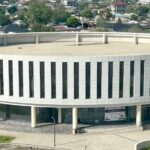
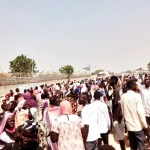
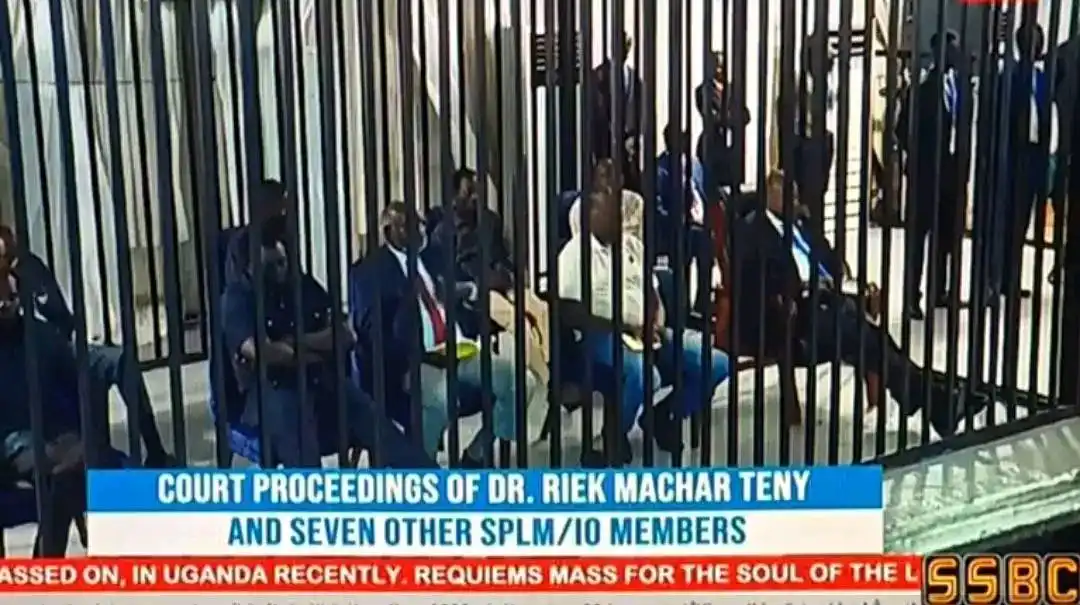
The court session, held at Freedom Hall under heavy security, was broadcast nationally and marked Machar’s first public appearance since he was placed under house arrest in March. Roads leading to Customs, Konyo Konyo and Juba Town were closed, forcing residents to use nearby footpaths.
Machar appeared in a defendant’s cage alongside seven co-accused, who together face charges including treason, crimes against humanity, murder, conspiracy, terrorism and destruction of public property and military assets. The charges are linked to an attack on a government garrison earlier this year.
His defence team, led by Dr Gari Raymond Lege, filed four objections to the proceedings. They argued the Special Court lacks competence and jurisdiction, questioned the participation of private lawyers within the prosecution team, and claimed that Machar is protected by immunity as the sitting First Vice President.
They also invoked provisions of the 2018 Revitalised Peace Agreement, which they said provide that the First Vice President can only be removed by impeachment through a two-thirds majority in the National Legislature.
“We have an objection to the establishment of this Honorable Special Court,” Dr Lege told the judges. “Dr Riek Machar, as First Vice President under Article 103 of the Transitional Constitution, should not be tried by this court, which lacks jurisdiction.”
The defence called for the Special Court to be declared null and void and requested the immediate release of Machar and his co-accused. They insisted that the government must respond in writing rather than verbally.
The prosecution, led by Counsel General Deng Achuil Adija, dismissed the objections as weak and unsubstantiated. Advocate Ajo Noel Ohisa argued that the court has full authority under the Constitution and Judiciary Act of 2008, which allows the creation of courts and tribunals when required.
“These members are all justices of the Supreme Court,” Ohisa said. “Even if their powers mirror those of a High Court, the High Court has unlimited jurisdiction to entertain such matters.”
He further stressed that the charges filed stem from the Penal Code Act’s chapters on offences against the state and the armed forces.
Presiding Judge James Alala Deng, alongside Judges Stephen Simon and Isaac Pur Majak, granted the defence’s request for written submissions and adjourned the hearing until Tuesday morning. The panel will review the objections before ruling on whether the trial will proceed.
The case has attracted close public and political interest, with critics viewing it as a test of South Sudan’s judicial independence.
Meanwhile, the Union of Journalists of South Sudan (UJOSS) condemned the decision to bar reporters from attending the hearing. Only state owned South Sudan Broadcasting Corporation (SSBC) journalists were allowed inside Freedom Hall.
UJOSS President Oyet Patrick Charles described the restriction as an attack on press freedom guaranteed under Articles 24 and 32 of the Transitional Constitution.
“It is dismaying that the Ministry of Justice, which should protect the Constitution, is the one imposing restrictions,” he said.
The body called for full media access to Machar’s trial and all cases of public interest.
The court’s decision on the defence’s preliminary objections will determine whether one of South Sudan’s most politically sensitive trials moves forward.
Discover more from Access Radio®
Subscribe to get the latest posts sent to your email.