










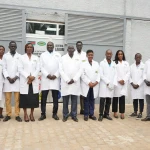





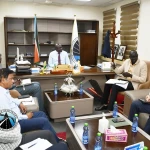
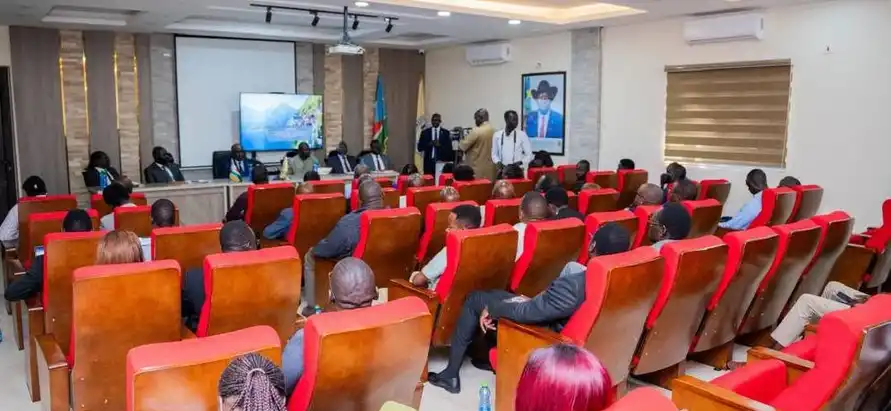
(JUBA) – A delegation from Zambia has visited the South Sudan Revenue Authority (SSRA) to learn from the country’s experience in digital revenue collection and tax administration.
The visit focused on electronic systems designed to improve transparency, accountability and revenue mobilisation.
The delegation visited the SSRA headquarters on Wednesday, 14th October 2026.
The visit reflects Zambia’s interest in understanding South Sudan’s digital revenue administration systems and exploring practices that could help strengthen tax collection and public financial management in Zambia.
The delegation comprises officials from Zambia’s Ministry of Finance and Trade, alongside representatives of CapitalPay International’s operations in Kenya and Uganda.
During the visit, the team participated in practical demonstrations of SSRA’s electronic revenue collection platforms, including e-Tax, e-Customs and SSCAFFA.
The delegation also engaged with clearing and forwarding agents to understand existing procedures, operational challenges and opportunities for further digital transformation.
Speaking during the engagement, SSRA Commissioner General Rizig Dominic Samuel highlighted the role of digitalisation in improving revenue collection, strengthening accountability and reducing revenue leakages.
He said the introduction of electronic payment systems had helped increase monthly collections while making revenue transactions easier to track and verify.
He further explained that digital systems had replaced some of the previous manual procedures, which he said created opportunities for manipulation and the misappropriation of public funds.
He said revenue is collected through the system, and as the Commissioner General, he would not just pocket it and take it to his family in the house without a record because it is digital.
He added that anybody can count and account for it or check it in years to come, stressing the importance of transparent and traceable revenue transactions.
He added that under the previous paper-based system, some officers could manipulate receipts and tax forms, making it difficult to verify the amounts collected.
Under the electronic system, taxpayers make payments directly through authorised commercial banks, allowing transactions to be recorded and monitored.
He explained that before, receipts were written on pieces of paper, and the officers deployed in customs or domestic tax usually became rich men overnight.
He said they could collect, fake their own forms, put whatever they wanted and give the people of South Sudan whatever they wanted to give.
But now they cannot do that because it is collected in the system, and the money must be paid directly to the banks.
The Commissioner General also acknowledged the contribution of technical partners, including CapitalPay, in implementing and supporting the Authority’s digital revenue systems.
In his part, Charles Abuy, Managing Director of CapitalPay in South Sudan, said revenue collection had improved following the rollout of the e-Tax and e-Customs platforms.
Abuy explained that CapitalPay International provides digital payment systems and software infrastructure to governments, businesses and supporting institutions across several African markets.
He said the company’s engagement in South Sudan forms part of the Government’s broader public sector digitalisation programme.
This follows a Council of Ministers resolution directing government institutions to digitise their services.
Abuy clarified that CapitalPay’s role is limited to providing, maintaining and supporting the technology and payment infrastructure used in electronic payments and revenue administration.
He emphasised that the company does not directly collect, hold or control government funds.
Instead, taxpayers make payments through authorised commercial banks, while CapitalPay serves as a technical contractor supporting the Authority’s digital revenue systems.
Discover more from Access Radio®
Subscribe to get the latest posts sent to your email.