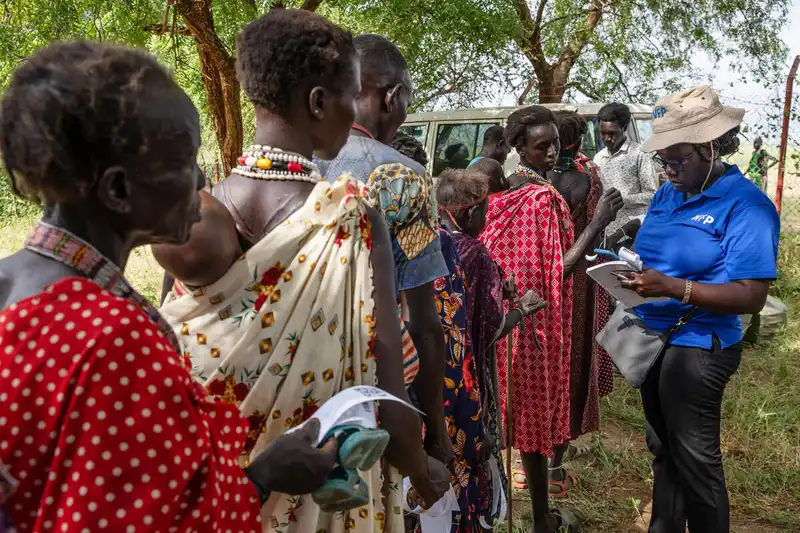
WFP staff reading a cash voucher presented by a beneficiary receiving Anticipatory cash assistance in Kapoeta North County, Eastern state. Photo Credit: WFP/ Gabriela Vivacqua
JUBA, South Sudan – The United Nations World Food Programme (WFP), in partnership with the Government of South Sudan, has activated the country’s first-ever drought anticipatory action plan, providing early assistance to more than 65,000 people in Eastern Equatoria State as the threat of severe drought intensifies.
In a news release extended to Access Radio on Monday, WFP said the landmark initiative is targeting vulnerable communities in Budi and Kapoeta North counties, where prolonged dry conditions threaten food production, livestock and household livelihoods. By acting before the full effects of the drought are felt, WFP aims to help families protect their assets, maintain food security and strengthen resilience against climate-related shocks.
Under the anticipatory action programme, WFP has begun delivering cash transfers and early warning messages to communities identified as being at high risk of drought-induced food insecurity. The intervention is designed to support households ahead of worsening conditions, enabling them to prepare and reduce potential losses.
“Anticipatory action is transforming the way we manage climate-related shocks,” said Mutinta Chimuka, WFP Country Director in South Sudan. “Rather than wait for drought to deepen humanitarian needs, we are acting based on forecasts and evidence to support communities before livelihoods are disrupted. By delivering assistance early, we can help families protect what they have, strengthen their resilience, and reduce the human and economic costs of drought.”
WFP said cash assistance is benefiting 52,751 people, helping families meet essential food and livelihood needs while reducing reliance on negative coping mechanisms. In addition, more than 65,000 people are receiving drought preparedness information through awareness campaigns focused on water management, livestock care, livelihood planning and drought mitigation measures.
Eastern Equatoria’s agro-pastoral communities rely heavily on seasonal rainfall for crop cultivation and livestock production. When rains fail, households often face crop losses, livestock deaths and declining incomes, increasing the risk of hunger and economic hardship.
The activation of the drought response plan was made possible through US$2.45 million in funding, including US$1.08 million from the Korea International Cooperation Agency (KOICA) and US$1.37 million from Germany. Earlier support from the Government of Ireland and KOICA also helped establish South Sudan’s anticipatory action framework and improve preparedness for rapid response.
According to WFP, the initiative marks a significant milestone in South Sudan’s efforts to adopt proactive approaches to disaster risk management. By combining scientific weather forecasts, early warning systems and pre-arranged financing, humanitarian partners aim to minimise the impact of climate shocks before they escalate into emergencies.
The programme is expected to help vulnerable households withstand the effects of drought, safeguard livelihoods and protect development gains in one of South Sudan’s climate-sensitive regions.
Discover more from Access Radio Yei News
Subscribe to get the latest posts sent to your email.