





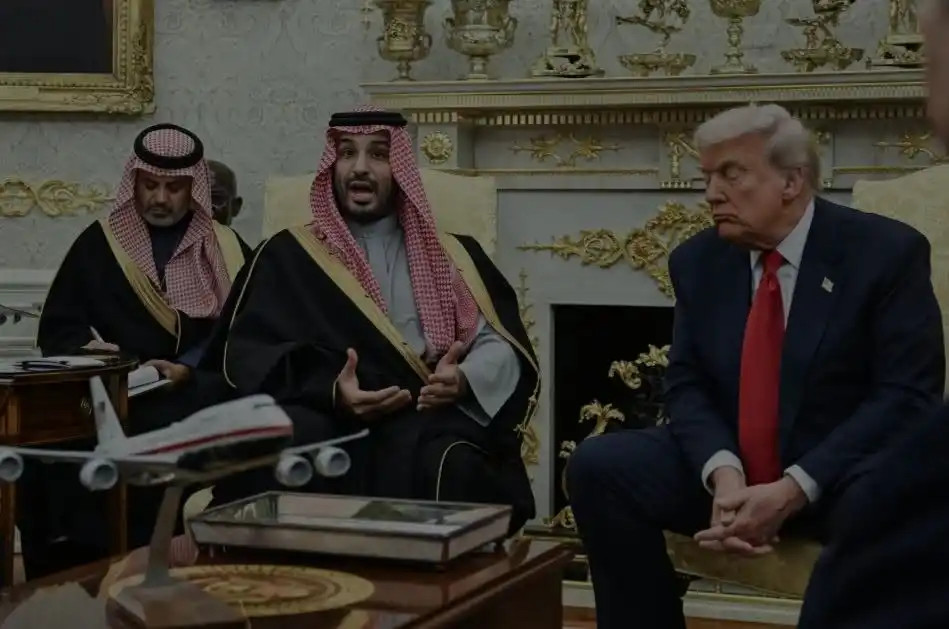
(WASHINGTON) – A serious rift opened between President Donald Trump and Saudi Crown Prince Mohammed bin Salman during the Iran war, after the Kingdom refused to let American forces use its airspace for a mission to escort commercial ships through the Strait of Hormuz, forcing the Pentagon to shut down the operation within 48 hours.
The mission, called Project Freedom, was announced early in the conflict after Iran had effectively closed the strategic waterway. United States Central Command said naval and air power would ward off any Iranian attacks during a tentative ceasefire. But American commanders were caught by surprise when Saudi officials said US forces could not use the Kingdom’s airspace, as Washington had not consulted Riyadh beforehand.
That triggered a flurry of tense phone calls between Washington and the Crown Prince. An outraged President Trump spoke with him on 4 May, the first day of the operation, and on the next two days as well, US officials said. Vice President JD Vance talked to the prince in a separate call, as did Steve Witkoff, the special envoy to the Middle East, and Jared Kushner, Trump’s son in law. Marco Rubio, the White House national security adviser, spoke to his counterpart.
The Crown Prince held his ground, fearing the American plan could reignite full scale war. The Trump administration was forced to shut down Project Freedom less than 48 hours after it had begun.
“They had lost confidence in the administration, and they thought if they let the US use their airspace, they would get hit even harder by Iran,” said Hussein Ibish, a scholar at the Arab Gulf States Institute in Washington.
The all hands campaign by the White House to sway Prince Mohammed, which had not previously been reported, and other key moments during the war revealed American and Saudi officials becoming increasingly at odds over how to approach security in the region, particularly on Iran and Israel. Increasingly, the Saudis see the US government as unreliable and even on occasion a risk to Gulf Arab nations.
Since the United States and Israel attacked Iran on 28 February, Saudi Arabia has tried to chart a middle course to protect its interests. It gave military and diplomatic support to the United States, and was attacked by Iran. But the Kingdom has also opposed Trump at critical moments, flexing its muscles when it sensed greater dangers resulting from American and Israeli aggression.
As Trump tries to navigate diplomacy with Iran, with a focus on Tehran’s nuclear programme, Saudi Arabia continues to carry out its own initiatives, veering away from American priorities and moving to strengthen ties with other nations. That includes Pakistan and China, which helped broker a diplomatic opening between the Kingdom and Iran in 2023. The Saudi foreign minister is visiting China this week.
Because of that opening, Saudi officials are speaking directly to their Iranian counterparts about Iran’s control of the strait, missile arsenal and support for regional militias, all of which the Saudi leadership considers a bigger threat than the nuclear issue.
Prince Mohammed has carried out the balancing act all year. He laid out the risks of war to Trump before the conflict started, then later urged the American president to continue the fighting to destroy the Iranian government, according to people briefed by US officials. Saudi Arabia has denied this. But as Iranian power persisted, Prince Mohammed pushed for a settlement.
The Kingdom, along with the United Arab Emirates, launched secret retaliatory attacks against Iran at one point in the war. Prince Mohammed, however, was not as enthusiastic about escalation as the Emirati leader, said current and former US officials. At the same time, Prince Mohammed was more aggressive than his counterparts in Qatar and Oman, who act as diplomatic brokers between the United States and Iran.
Now, as the Trump administration tries to reach agreements with Iran that go beyond the preliminary ceasefire accord announced on 14 June, Saudi Arabia and other Gulf Arab nations are pressing for an outcome that would shield them from fallout if Iran, Israel or the United States restart broad hostilities.
Given Trump’s vacillations during the war, the Saudis question whether the Americans would offer any protection or exercise sound judgment in a future conflict. The Saudis became sceptical of Trump in 2019, when he refused to retaliate against Iran for a drone and missile attack on Saudi oil fields.
“We start a big fight, then get bored and walk away,” Ibish said. “It’s like Lucy and the football. They’re feeling like Charlie Brown on the ground.”
Anna Kelly, a White House spokeswoman, said Trump has a “great relationship” with Saudi Arabia. “President Trump listens to a variety of opinions on any particular issue, and he takes seriously the input of our regional partners,” she said. “Ultimately, he makes all decisions based on what is best for the American people and our national security.”
The Saudi foreign ministry did not reply to a request for comment.
Aspects of the US Saudi partnership remain strong. The two governments have been talking for months about how to start a civilian nuclear programme in the Kingdom after an agreement they reached last year, a US official said. The Trump administration could soon present a plan to Congress, though some American lawmakers and Israeli officials fear the Crown Prince could try to develop nuclear weapons.
Washington and Riyadh are also discussing how to build up overland routes that bypass the Strait of Hormuz. And Saudi Arabia remains by far the biggest buyer of American weapons.
In both of Trump’s terms, Saudi Arabia was his first major overseas trip. Kushner maintains close ties with Prince Mohammed and travels to Riyadh often, despite having no government role. Four years ago, Kushner got a 2 billion dollar investment from a fund led by the Crown Prince.
Yet Trump mocked Prince Mohammed in public during the war. In March, Trump talked in disparaging terms about how he thought the prince had underestimated him and his administration. “He didn’t think he’d be kissing my ass,” Trump said at an investment forum in Miami that Saudi Arabia had organised.
There are other signs of tension. When Rubio, who is also the secretary of state, visited the Persian Gulf last week, he skipped Saudi Arabia while stopping for meetings in Bahrain, Kuwait and the Emirates, an archrival of the Kingdom.
In Bahrain on Thursday, diplomats from the Gulf Arab nations met with Rubio to voice their concerns about regional security. The Saudi foreign minister, Prince Faisal bin Farhan, also spoke one on one with the secretary.
“This alliance was put to the test based on recent events,” Rubio said at the group meeting, “and it has passed, meaning that the level of cooperation, the level of interaction, the level of friendship that existed among us during these trying times was put to the test, and it passed with flying colours.”
While Saudi Arabia is relieved by the ceasefire, none of the most difficult issues emerging from the war have been dispelled by the preliminary agreement. The agreement recognises that Iran has some form of control over the strait and allows for it and Oman to agree to a method of administration, which could include charging tolls or fees in the long term.
“The moment Iran closed the Strait of Hormuz, the whole psychology of the Gulf changed,” said Michael Ratney, a career diplomat who was the US ambassador to the Kingdom, before he retired at the start of the second Trump administration. “Now Iran has this sword of Damocles that they can hold over the Gulf economy and the global economy.”
The preliminary document also says nothing about Iran’s ballistic missiles and its support for militias. And it is unclear whether the Trump administration will be able to get Iran to enter a nuclear agreement. In 2018, Trump withdrew from an Obama era deal that Iran had been abiding by, which prompted Iranian leaders to enrich uranium to higher levels.
In public, the Saudis have praised Trump’s memorandum of understanding with Iran, which laid the foundation for the ceasefire.
“I think it’s incredibly important and very significant that we have an M.O.U. that will hopefully put an end to this conflict and, more importantly, open the pathway towards resolving many of the outstanding issues,” Prince Faisal, the foreign minister, said on 18 June at a forum in Vienna. “Primary among them, of course, is the nuclear issue.”
But Saudi officials are adopting a wait and see approach on outcomes of the agreement. They have not committed any funds to rebuilding Iran, which the agreement calls for from America and its regional partners.
Discover more from Access Radio®
Subscribe to get the latest posts sent to your email.