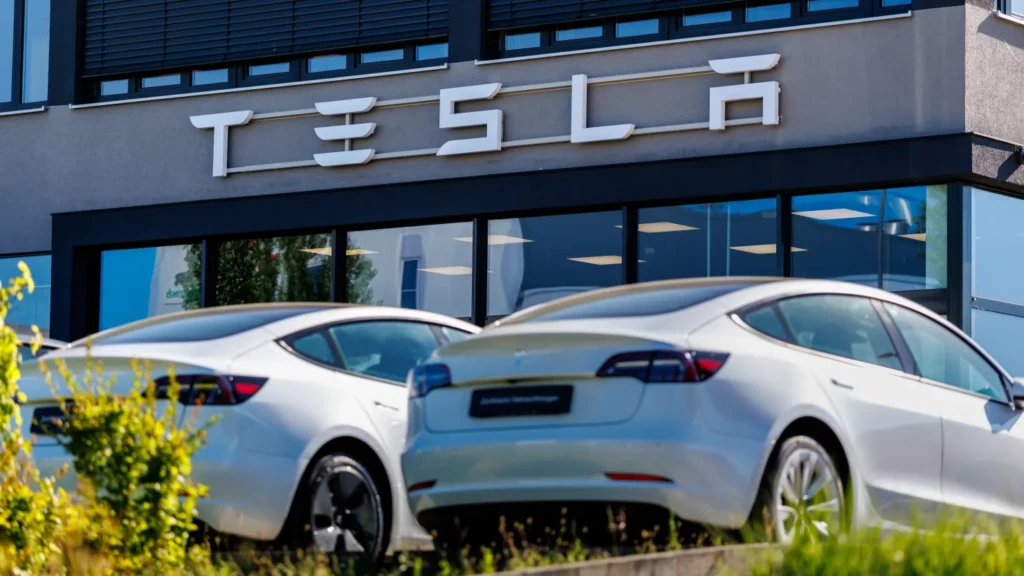
Tesla Shares Drop 7 Percent Despite Strong Delivery Figures / PHOTO: Unsplash
(AUSTIN) – Tesla shares fell 7.49 percent on Thursday, their worst single day drop in almost a year, even after the electric vehicle maker reported quarterly delivery numbers that far exceeded Wall Street expectations, as concerns over trade policy and component costs weigh on the global auto industry watched closely by emerging market importers.
Tesla reported total vehicle deliveries of 480,126 for the second quarter, well above the 406,600 figure that analysts had expected according to StreetAccount consensus. Tesla’s own company compiled consensus published last week was 406,024 deliveries.
Total vehicle production for the quarter reached 451,758 units. The update showed a 25 percent year on year increase and a 34 percent rise compared with the first quarter of 2026, when deliveries came in at 358,023. In the same period last year, Tesla reported around 384,000 deliveries.
Tesla does not break out exact delivery numbers by region or individual model, but the company said its entry level Model 3 sedan and most popular Model Y sport utility vehicles accounted for 467,762, or 97 percent of its deliveries. Deliveries are the closest approximation of sales reported by Tesla but are not precisely defined in its shareholder communications.
The stock has now fallen on each of the past three quarterly delivery reports.
Tesla is trying to recover from consecutive annual declines in vehicle sales that were partly caused by a consumer backlash against Chief Executive Officer Elon Musk, the world’s wealthiest person, and by the loss of a US federal tax credit. Musk’s incendiary political rhetoric, endorsements of anti immigrant extremists in Europe, and his work with the Trump administration to shrink the federal workforce drove away some prospective electric vehicle buyers.
Chinese automakers like BYD, Nio and Xiaomi have come to market with an array of more affordable and high tech EVs, while Tesla also faced increased competition from South Korea’s Hyundai Motor Group and European electric vehicle makers including Volkswagen.
To revitalise sales, Tesla started selling lower cost versions of its Model 3 and Model Y vehicles, and more recently made its driver assistance systems, marketed under the brand name Full Self Driving (Supervised), available in some European markets.
The biggest boost for the company in the quarter may have been soaring fuel prices resulting from the war in Iran. European car buyers purchased more Tesla and other EVs in the first half of the year. However, oil prices are now back near where they were trading before the war began in February, in response to a fragile truce between the US and Iran, and diplomatic efforts to bring the conflict to a lasting conclusion.
In the US, car buyers have pulled back from fully electric vehicles and are embracing hybrids, according to Dan Hearsch, managing director at AlixPartners.
“We have a huge country, and people live far away from each other compared to Europe where the charging infrastructure is better and people don’t have to drive quite so far,” Hearsch said.
In the second half of the year, inflation, shifting trade policy, the rising cost of chips and other components may pose the biggest challenges to US automakers, he added.
Musk has directed Tesla to focus on ramping production and sales of its Semi electric trucks, and to start production of its driverless Cybercab. The company is also looking to begin production of its Optimus humanoid robots.
In Tesla’s first quarter investor update, the company said it was “optimising” its vehicle portfolio, “with an emphasis on vehicles designed for a fully autonomous future” and expected “volume production of both Cybercab and the Tesla Semi this year.”
Tesla said in January that it would stop producing its flagship Model S and X vehicles, and would use their factory lines in Fremont, California to build Optimus units.
In its Energy business, which installs solar photovoltaics and sells battery energy storage systems, Tesla said it deployed 13.5 gigawatt hours in the second quarter of 2026, compared to 9.6 gigawatt hours a year ago. Analysts expected 13.3 gigawatt hours.
Musk’s SpaceX, which owns xAI, bought 269 million dollars worth of Tesla Megapacks in April, according to its initial public offering filing. SpaceX is using the Megapacks to reduce xAI’s electricity costs at its power hungry data centres in and around Memphis, Tennessee.
In the second quarter deliveries report, Tesla did not disclose whether related party transactions contributed to the strong numbers. Last year, SpaceX spent 131 million dollars purchasing Tesla Cybertrucks. That dollar amount represented a large portion of the 20,237 Cybertrucks Tesla sold in 2025, according to Kelley Blue Book.
Tesla plans to report second quarter financial results on Wednesday, 22 July, after the market’s close.
Discover more from Access Radio Yei News
Subscribe to get the latest posts sent to your email.