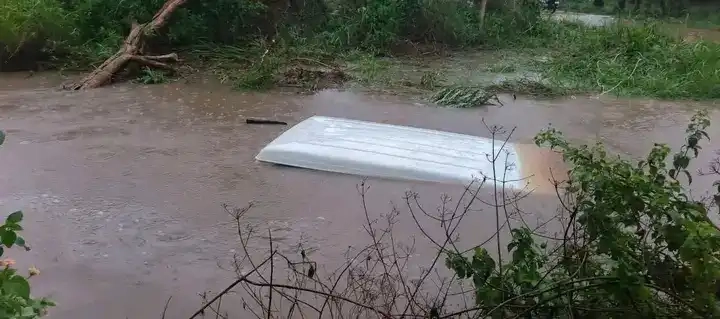
The flooded Lubajo Stream
(OPINION / DR. KOITI EMMILY) – There are moments when the weight of a place reaches you not through headlines, but through the quiet unfolding of an ordinary evening.
I had just returned home from a long day of errands. I had also kept away from the media channels through which I usually consume news. As my mother and I sat catching up, moving through the small, familiar details of the day, her tone shifted.
She spoke of Kajo Keji. Of Lubajo Stream, near the airstrip and Mundari Civil Hospital—officially known as Kajo Keji County Hospital. She described heavy rains that had flooded its banks, and a vehicle carrying twelve people that attempted to cross.
Eight did not make it. Mostly women. A child.
The conversation paused there, as such conversations do—not because there is nothing more to say, but because the weight of what has been said must first be held.
My mother was not simply relaying news. She was grieving—quietly, deeply—for a place she has lived in and served for many years, for lives that are not distant abstractions but part of a shared community fabric. Then, almost as an extension of that grief, she offered something else. Not as an accusation, not in anger, but as a careful remembering.
The trees along Lubajo Stream, she said, had been cut down over time. She had watched it happen. At different moments, there had been gentle attempts to encourage restraint, but those efforts did not always hold. She did not present this as the sole cause, but as something we must not overlook.
Her words did not feel unfamiliar. They settled into a memory I had not actively been holding, but which remained quietly intact. In my early days working in Kajo Keji in 2022–2023, I commuted to the hospital from our village home in Mere, using that same road. It was a routine journey, marked by both familiarity and a sense of return.
And yet, even then, something had shifted.
The landscape no longer held the same density of trees I remembered from my childhood in the late 1990s. It was not an abrupt change, but a gradual thinning—subtle enough to escape immediate alarm, yet visible to anyone who had known the place long enough.
In moments like these, it is both natural and necessary to reach for large, visible solutions. Already, voices are rightly calling for the long-delayed Juba–Kajo Keji road to finally be constructed. That call carries weight. Infrastructure matters. Roads connect communities, ease movement, and, when properly designed, save lives.
Yet there is a quiet risk in placing all our hope in distant, capital-intensive solutions while overlooking those within our immediate reach.
What happened at Lubajo is not only a story of a missing road. It is also a story of a landscape gradually altered in ways that are easy to miss—until they converge into tragedy.
Trees along streams are not merely aesthetic features. They are, in many ways, living infrastructure. They absorb rainwater, slow its movement, bind soil together, and regulate how a stream behaves under stress. When they are removed, the stream does not remain what it once was. It becomes faster, shallower, and less predictable. It loses its capacity to absorb shock.
And so, when the rains come—as they did this week, earlier and heavier than many anticipated—the water does not negotiate. It rushes. What was once a manageable crossing becomes a force. What was once familiar becomes fatal.
This is not a moment for condemnation. Communities cut trees for reasons that are often deeply practical: building homes, sourcing fuel, sustaining livelihoods. These are not decisions made with the intention of harm.
And yet, wisdom asks us to hold two truths at once: that people act out of necessity, and that those actions, over time, reshape the risks we all carry.
The loss of life at Lubajo is therefore not the failure of a single individual, a single driver, or a single moment. It is the convergence of many small, accumulated changes—environmental, infrastructural, and behavioral—meeting at once.
For this reason, our response must also follow more than one pathway.
The call for the construction of the Juba–Kajo Keji road must continue—with urgency. But even in the most optimistic scenario, such a project will take time—time the seasons do not grant us. The rains will come again, whether the road is built or not.
Which means that alongside long-term infrastructure, there must be a parallel commitment to immediate, locally driven solutions.
Restoring vegetation along Lubajo Stream and similar waterways is not symbolic; it is practical. Replanting trees, protecting buffer zones where cutting is restricted, and mobilizing communities—particularly local leaders and youth—to take ownership of restoration efforts are steps that can begin now.
They require coordination and commitment, but not the long timelines of national projects. They represent a form of development that is both accessible and urgent.
There is something profoundly instructive in what my mother shared. Before policy, before funding, before national attention, there were conversations. There was awareness. There were attempts—however gentle—to guide decisions differently.
This reminds us that communities are not passive recipients of change. They are active participants in shaping it. The same agency that allows environmental degradation to occur is the very agency that can reverse it.
What is required is not only information, but alignment—an agreement that what is being protected is shared, and what is being risked is collective.
We often associate urgency with what is visible: announcements, contracts, machinery breaking ground. But there is another kind of urgency—quieter, yet no less important.
It asks what can be done now, with what is already within our reach.
It recognizes that planting a tree does not require a budget cycle, and protecting a streambank does not require years of study. It requires leadership, yes—but also consensus, and a shared willingness to act before the next crisis forces our hand.
The lives lost at Lubajo must not fade into the rhythm of passing news. If they are to be honored, it will not be through grief alone, but through attention—attention to the land, to the systems we neglect, and to the small decisions that accumulate into consequences far greater than we intend.
It will also require us to listen more carefully to insights that do not come wrapped in policy language, but emerge from lived experience—from those who have watched a place long enough to recognize when it is no longer behaving as it once did.
When my mother finished speaking, there was a pause. Not because there was nothing more to say, but because everything that needed to be said had already been offered—simply, and without insistence.
Sometimes, the most important insights do not arrive through formal channels. They come quietly—through observation, memory, and care.
The question before us—the people of Kajo Keji—is whether we are willing to listen, and whether we are willing to act before the next stream rises.
May the Lord grant mercy and comfort to all who lost loved ones at Lubajo.
Dr Koiti Emmily is a physician, a Sexual and Reproductive Health and Rights (SRHR) specialist, and a coach on the ICF-ACC pathway. She writes on health policy, governance, leadership, and peacebuilding. To join her growing community, follow her on Facebook.
DISCLAIMER
Access Radio® provides a platform for diverse perspectives through our opinion articles. The publication of this piece does not imply an endorsement by Access Radio® or its editorial team.
Authors and commentators are responsible for the factual accuracy of their submissions. Access Radio® does not independently verify all claims made in opinion pieces.
We encourage thoughtful dialogue and welcome contributions from our community. To submit your opinion, please email news [at] radioyei.org.
Please note that all submissions may be edited for grammar, clarity, style, or length at the discretion of the Access Radio® editorial team.
Discover more from Access Radio Yei News
Subscribe to get the latest posts sent to your email.