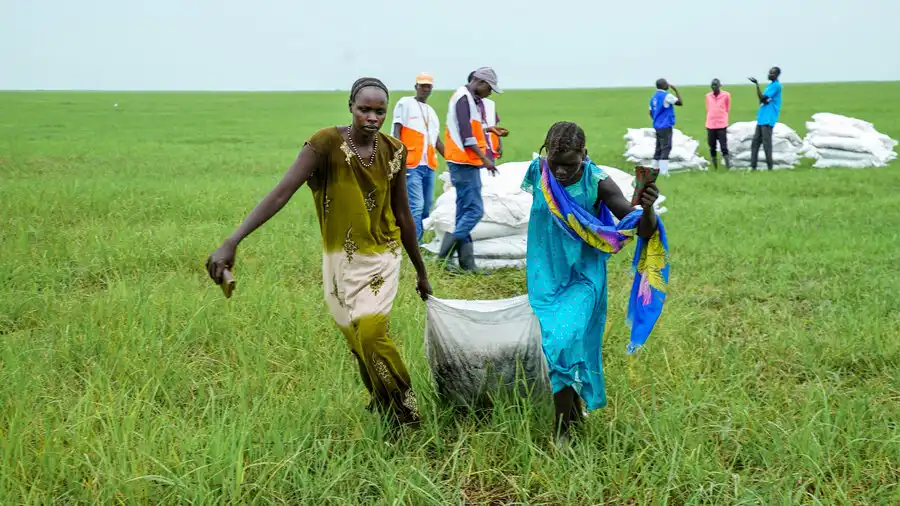
Nyaduoth (L) and a fellow villager drag WFP food assistance away from an airdrop zone. Photo: WFP/Peter Louis
(JUBA)—At least seven counties in South Sudan are at risk of sliding into famine if urgent assistance is not delivered, according to the latest findings of the Integrated Food Security Phase Classification projection for April to July 2026.
Released on Tuesday by the government and United Nations agencies, the report puts counties including Akobo and Nyirol in Jonglei State, as well as Nasir and Ulang in Upper Nile State, among areas facing high risk of famine, alongside several other hard-hit locations.
The findings estimated that 7.9 million people, more than half the population, are projected to face high levels of acute food insecurity, classified as IPC Phase 3 (Crisis) and above. This marks an increase of about 280,000 people compared to projections made in late 2025.
Within this number, the report states that around 73,000 people are already experiencing catastrophic conditions, classified as IPC Phase 5, where households face extreme food shortages, starvation, and the near-total collapse of livelihoods.
A further 2.5 million people are in emergency levels of hunger, while more than 5 million are in crisis and unable to meet basic food needs without resorting to harmful coping strategies.
The nutrition situation is equally concerning. The report further revealed that cases of acute malnutrition among children under five have risen to 2.2 million, while about 1.2 million pregnant and breastfeeding women are also in need of urgent nutritional support.
While announcing the latest findings, Deputy Minister of Agriculture, Lily Albino Akol, said the crisis is being driven by combination of factors, including conflict, displacement, economic hardship, and climate shocks.
She said continued insecurity in parts of the country has displaced an estimated 280,000 people, disrupted farming and cut off access to markets and essential services.
Lily further stated that flooding and damaged infrastructure have further compounded the situation, while rising food prices have eroded households’ purchasing power.
Disease outbreaks such as cholera, measles, and malaria are worsening malnutrition, particularly in areas with limited access to clean water and healthcare, she added.
Humanitarian access remains a major challenge. Lily said that although there has been slight improvement in access since late March, many communities are still difficult to reach, leaving vulnerable populations at risk of catastrophic conditions.
Despite the severity of the situation, the government has cautioned against prematurely declaring famine, urging stakeholders and the media to rely on verified data while acknowledging the seriousness of the risks.
“The Government of the Republic of South Sudan calls upon all stakeholders to scale up coordinated, timely and adequately resourced interventions to avert further deterioration, prevent loss of life, and support the resilience and recovery of affected communities,” Akol said.
Meanwhile, a representative from the United States Embassy in South Sudan, Charles Vetter, blamed government actions for the worsening food crisis.
He said the transitional government had continued to wage conflict throughout the country, causing widespread displacement of hundreds of thousands across the country, driving the need further.
“We call urgently for the transitional government to end the conflict, to use its national revenue to serve the people of this country, including by paying salaries, and to end the obstruction directed towards those trying to help. With these actions, we feel we can make progress in ending the marginalisation of the South Sudanese people,” he added.
However, Lily stated that the government is committed to peace efforts and improving humanitarian access, stressing that stability will be key to addressing the country’s deepening food crisis.
Discover more from Access Radio Yei News
Subscribe to get the latest posts sent to your email.