

















(JUBA, SOUTH SUDAN) – South Sudan has begun a full-scale simulation exercise to test the country’s readiness to detect and respond to a potential Bundibugyo Ebola virus case in Juba, Yei and Yambio.
The exercise, announced by the Ministry of Health, runs from 19th to 23rd October. It will simulate the detection of a suspected case and test how health authorities coordinate emergency response, including surveillance, infection prevention and control, patient transport and isolation procedures.
“The exercise is intended to strengthen the country’s ability to prevent, detect and respond effectively to public health emergencies,” Caretaker National Minister of Health Dak Duop Bichiok said in a statement. “The exercise is a preparedness activity and should not be interpreted as a declaration of an outbreak.”
The Acting Executive Director of the National Public Health Institute said the scenario involves a suspected case detected at Juba International Airport and reported to the Emergency Operations Centre.
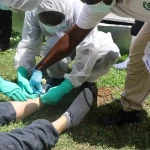
A rapid response team would then be deployed to manage the simulated incident, put infection prevention measures in place and arrange the transfer of the suspected patient by ambulance to an isolation unit.
The exercise is intended to assess coordination among health professionals, emergency response teams and government institutions, and to identify gaps that could affect the country’s response in a real public health emergency.
The NPHI official, Dr Adar, said Nimule had not been excluded permanently but would be considered in a second phase because of budget constraints.
He said Yei and Yambio were selected partly because of their proximity to international borders, while Juba was included as the national capital.
The decision to postpone activities in Nimule raises questions about the scope of the initial exercise and when the government intends to extend preparedness activities to other locations.
The press conference also raised questions about people crossing back into South Sudan from the Democratic Republic of the Congo.
Responding to journalists, the NPHI representative estimated that between 2,000 and 3,000 people had crossed back into the country around the Nabanga area of Ibba County, adding that the number was increasing.
The official did not give a precise date for when the movement began or further details about the people involved.
He said health teams were monitoring the situation and that people entering South Sudan were subject to screening and monitoring for possible deterioration in health.
The estimate was not accompanied by figures on the number of people screened or the results of any screening.
Minister Bichiok urged residents, particularly in Juba, Yei and Yambio, to cooperate with authorised exercise teams and follow guidance from health officials.
He warned that members of the public might see unusual movements of health personnel, ambulances and emergency response teams during the exercise, saying these activities should not be interpreted as evidence of an outbreak.
The minister also called on journalists, community leaders and other stakeholders to share verified information and avoid spreading unconfirmed reports that could cause unnecessary fear.
The NPHI was identified as the main technical institution responsible for coordinating public health emergency preparedness activities, with officials directing journalists to the institute for verified information on the exercise.
The minister said the government would continue working with national and international partners to strengthen disease surveillance, laboratory capacity, infection prevention and control, and emergency preparedness.
The exercise involves health authorities and other stakeholders in Juba, Yei and Yambio. Officials did not provide a detailed schedule of activities or specify how the results would be evaluated.
The Ministry of Health said the exercise was intended to identify weaknesses in the country’s emergency response systems and improve coordination before a public health emergency occurs.
Discover more from Access Radio®
Subscribe to get the latest posts sent to your email.