














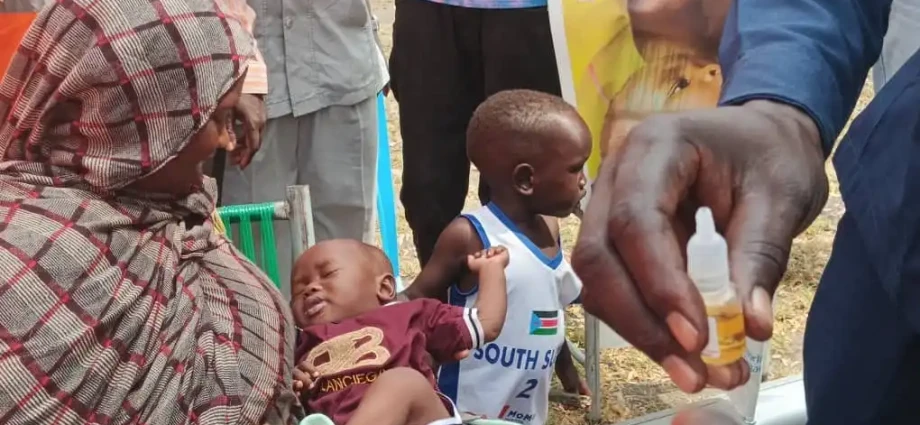
(JUBA) – The World Health Organization (WHO) recommends a four-dose malaria vaccine schedule for children, with the fourth dose given in the second year of life to extend protection.
South Sudan’s rollout has reached all 80 counties. But a government-led Post-Introduction Evaluation (PIE) shows most children who start the schedule do not finish it. The sharpest drop comes before the final dose at 18 months.
The PIE found high awareness among caregivers. 90% know about the malaria vaccine, and 93.1% keep their children’s vaccination cards. Yet only a small fraction of children complete the full series.
Programme data cited in the evaluation show the scale of the gap. Between August 2025 and July 2026, 428,289 children received the first dose. Of these, 294,545 returned for the second dose and 228,342 for the third. Just 90,104 received the fourth.
The evaluation describes the problem as one of continuity, not acceptance. More caregivers reported motivation to vaccinate than hesitancy. Only 18.5% of health facilities reported community resistance.
Misconceptions persist, however. Some caregivers believe malaria vaccination can replace the use of insecticide-treated mosquito nets.
The vaccine was introduced in 28 high-burden counties in July 2024. It was expanded nationwide by August 2025. Doses are given at 5, 6, 7 and 18 months of age. The fourth dose is delivered alongside the second dose of measles-containing vaccine.
The evaluation calls this a chance to strengthen immunization in the second year of life. But follow-up systems remain weak. Only 27% of counties have defaulter-tracking systems. 22% reported effective tracking for children aged 9 to 18 months.
Consistent outreach services were conducted in just 41% of counties. About 18% of vaccination cards were not fully updated.
Access barriers also persist. Approximately 44% of the population lives within reach of consistent primary healthcare services. Children who did not need transport to reach services had 87% lower odds of being off-track for vaccination. One sampled county could not be accessed because of insecurity.
The evaluation points to operational gaps in planning and data. Only 51.7% of counties had county-specific plans. 17% reported documented forecasting methods, and 16.8% of facilities reported malaria vaccine stock-outs.
No structured malaria vaccine data quality audit had been conducted. Only 19% of counties used data for microplanning.
Staff training is widespread. Some 88.2% of facilities reported trained staff. But only 11.8% had received refresher training, and job aids were available in 57.1% of facilities.
Solar refrigerators were in use in 96.6% of facilities. 89.9% maintained recommended storage temperatures.
On safety, 81.5% of facilities had staff trained in recognising adverse events following immunization. But only 14.3% reported such events, and 26% of counties were able to investigate them.
The evaluation recommends several steps. It calls for stronger second-year-of-life immunization by linking malaria vaccine tracking with measles vaccine services.
It also recommends a data quality audit and better caregiver counselling on the four-dose schedule. Other steps include expanding outreach in flood-prone and hard-to-reach areas and reducing stock-outs through better forecasting.
The evaluation further calls for defaulter tracing through community health workers. The findings are consistent with earlier WHO data from the first phase, which showed a 73% dropout from the first to the third dose.
Malaria remains a major threat in South Sudan. The country recorded 5.5 million cases and over 4,000 deaths annually, according to WHO.
Discover more from Access Radio®
Subscribe to get the latest posts sent to your email.