


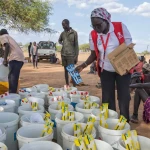

(JUBA) – South Sudan has launched the second phase of its R21 malaria vaccine campaign, extending coverage to 52 additional counties in a drive to protect 324,571 children aged between five and 23 months from one of the country’s deadliest diseases.
The scaleup, led by the Ministry of Health with support from the World Health Organisation (WHO), UNICEF, Gavi, and JSI, follows the first phase in July 2024, which targeted 28 counties with the highest malaria burden. That initial rollout aimed to reach more than 265,000 children.
Malaria remains endemic across South Sudan, with an estimated 5.5 million cases and over 4,000 deaths every year. A 2023 malaria indicator survey showed a sharp increase in prevalence among children aged six to 59 months, from 32 per cent in 2017 to 52.6 per cent in 2023, putting significant pressure on the country’s fragile health system.
The first phase achieved partial success. By August 2024, 91 per cent of targeted health facilities (503 out of 551) had received malaria vaccines, and 71 per cent (356 facilities) reported data on vaccine administration.
From July 2024 to May 2025, 148,878 children received the first dose. However, follow-up rates declined sharply, with only 83,668 children (56 per cent) returning for the second dose, 51,002 (34 per cent) for the third dose, and just 11,370 (7.6 per cent) completing the fourth and final dose.
“This steep dropout in the first round and the rising malaria-related deaths are deeply concerning,” said Minister of Health Sarah Cleto Rial. “We must strengthen service delivery, improve tracking of defaulters, increase community engagement and reinforce follow up systems.”
The R21 vaccine is given at five, six, and seven months of age, with a fourth dose at 18 months, coinciding with the second measles vaccine dose, which will also be introduced in August 2025.
Support from international partners has been significant. In the first quarter of 2025, WHO delivered malaria commodities worth $356,221 (about 1.64 billion South Sudanese pounds) to treat roughly 193,828 cases.
However, the 2025 national requirement for malaria commodities is $3,039,151 (about 13.98 billion SSP), and as of March 2025, only $766,463 (about 3.53 billion SSP) had been secured, leaving a substantial funding gap.
| Malaria Commodity Funding 2025 | USD | SSP |
|---|---|---|
| Total requirement | 3,039,151 | 13,980,094,600 |
| Funding secured | 766,463 | 3,527,729,800 |
| Funding gap | 2,272,688 | 10,452,364,800 |
UNICEF, through the Health Sector Transformation Project, has treated 1,268,701 malaria cases using first line antimalarial drugs, with 924,159 cases handled at health facilities and 344,542 treated in communities under the Boma Health Initiative. It has also supported public awareness campaigns and distributed more than 400,000 doses of the R21 vaccine in the first phase.
UNICEF Representative to South Sudan, Noala Skinner, described the expanded rollout as “a pivotal step in protecting South Sudan’s children from the devastating risk of malaria,” adding, “Every child deserves a childhood free from malaria. The R21 vaccine will help shield more children from sickness and death, enabling them to survive, thrive, and shape the nation’s future.”
The Ministry of Health is also preparing for a mass distribution of 9.5 million long lasting insecticide treated nets in 2026, in addition to vaccines and other interventions.
Discover more from Access Radio®
Subscribe to get the latest posts sent to your email.