






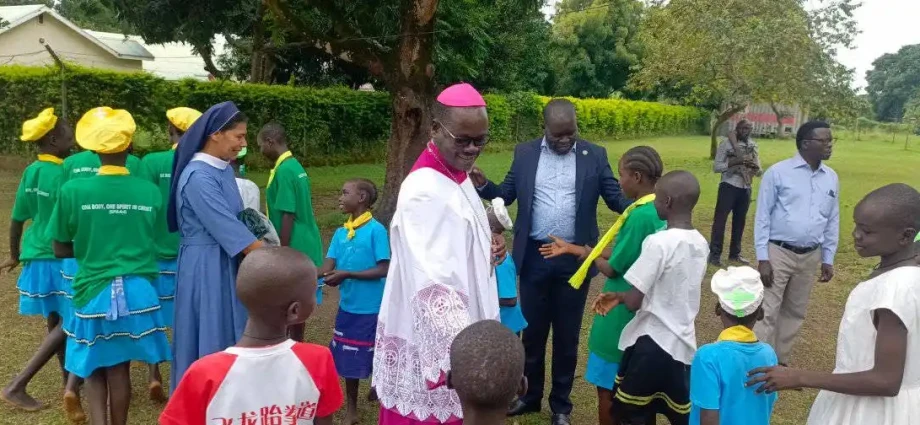
(YEI, CES) – Catholics in Diocese of Yei in Central Equatoria State are waiting up to six months for a priest to visit and administer the sacraments, the Bishop of Yei has said.
Bishop Alex Lodiong Sakor said insecurity, poor roads and a shortage of clergy are disrupting pastoral services across the diocese.
He said ongoing insecurity had made it difficult for priests and pastoral workers to reach remote communities. Safety concerns had also discouraged some missionary congregations from answering the diocese’s appeals for help, according to the Association of Member Episcopal Conferences in Eastern Africa .
“Because of the insecurity that is found in that area, many of these missionaries are afraid,” Bishop Lodiong said .
He said armed men remain in some rural areas, creating fear among pastoral workers travelling to villages to minister to Catholics.
The Bishop cited incidents in which two priests were allegedly harassed, taken into the bush and asked for money before being released. He added that catechists serving in remote communities have also faced repeated questioning about their presence in areas where armed groups operate .
According to the bishop, such experiences have heightened concerns about the safety of priests and catechists, particularly as they travel to communities far from major towns.
Despite the risks, he said the diocese continues to reach out to its faithful.
“We know that this is our duty. Whether things are difficult or not, we have to move to our people there,” he said .
Beyond insecurity, Bishop Lodiong said the condition of roads is another major obstacle to pastoral outreach. Some remote areas become inaccessible to vehicles during the rainy season.
He said the diocese has been adjusting its pastoral visitation strategy to prioritise the dry season, when travel to distant communities is more feasible.
He said poor road infrastructure makes journeys difficult and increases the risk of vehicles becoming stranded, especially when travelling without suitable transport.
The challenges are particularly serious in a diocese covering approximately 46,000 square kilometres. A limited number of priests must serve widely dispersed communities.
Bishop Lodiong said the diocese has only 18 priests. Some are experiencing health problems, making it difficult to provide regular pastoral care across its extensive territory .
As a result, some Catholic communities can wait as long as six months for a priest to visit and administer the sacraments.
The Bishop said the situation weighs heavily on him because Catholics living in remote villages need the same pastoral attention as those in urban centres.
“Sometimes many of our Christians even go for six months without being visited by their priests. And that, to me as a bishop, disturbs me,” he said .
He appealed for prayers and increased vocations to the priesthood. He also called on missionary congregations to help address the shortage.
The Bishop said four congregations of religious men are currently serving in the diocese and helping to reopen parishes that had been closed. He expressed hope that one or two additional congregations would join them.
The situation among religious sisters remains particularly difficult. According to Bishop Lodiong, only one congregation of sisters remains. The Cambodian missionaries previously serving in the diocese left because of a shortage of personnel .
The diocese is also struggling to rebuild institutions damaged during the conflict, including schools, health centres and priests’ residences.
Bishop Lodiong said the destruction of these facilities has created an additional financial burden at a time when local communities have limited capacity to contribute to reconstruction.
He said the country’s weak economic conditions have made it difficult for communities to raise the resources needed to restore essential services.
Efforts to secure support from development partners have also been challenging, he added. Some partners report limited funding from their own donors.
“Looking for money is becoming a bit tough for us,” the bishop said, describing fundraising for rehabilitation and reconstruction as one of the pressures facing his leadership .
The security concerns in Yei have been documented by other church sources. In January 2026, Bishop Lodiong told media that renewed military confrontations between government forces and opposition armed groups were worrying and contradicted the spirit of the peace agreement .
“Violence will not resolve political grievances and only causes suffering to civilians, including women and children,” he said at the time .
In October 2026, the South Sudan Council of Churches issued a statement noting that parts of Yei River County continued to experience armed insecurity, alongside attacks along roads connecting major towns in the Equatoria region .
Despite these difficulties, Bishop Lodiong said the diocese continues to make gradual efforts to provide education and healthcare services to local communities.
“We want to keep our people with us,” he said, appealing to well wishers and partners to support the diocese in restoring services to communities affected by conflict .
The Bishop called for solidarity with the diocese as it works to overcome insecurity, inadequate infrastructure, a shortage of clergy and financial constraints. He said Catholics in remote areas should not be left without pastoral care.
Discover more from Access Radio®
Subscribe to get the latest posts sent to your email.