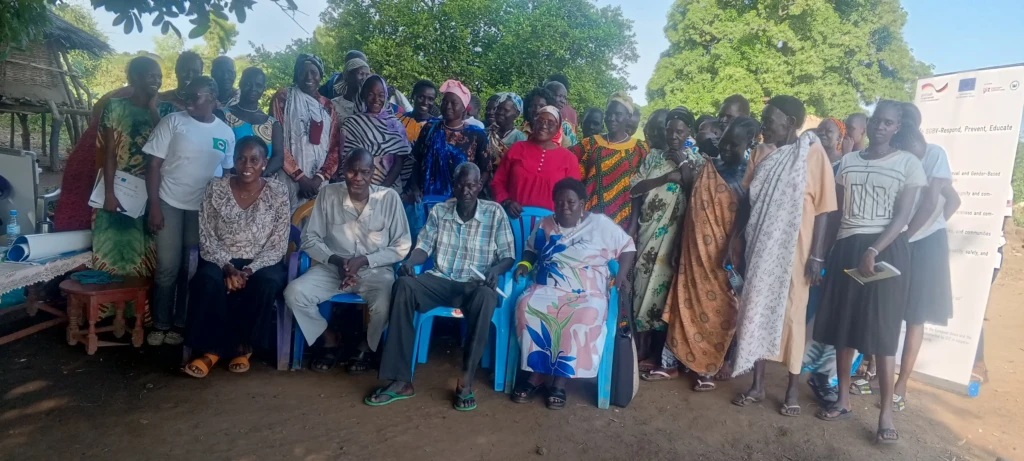
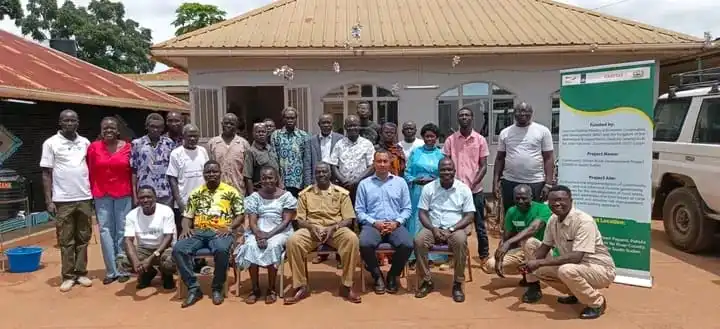
Women and girls in Gondokoro of Juba County pose for a photo during the beginning of the awareness workshop
Women and girls in Gondokoro of Juba County pose for a photo during the beginning of the awareness workshop
Listen to this article
(GONDOKORO)- Women and girls in Gondokoro of Juba County on Thursday began a three-day workshop aimed at raising awareness of the legal frameworks, including the Maputo Protocol, that protect women’s rights in South Sudan.
The training, organized by the Women Foundation for Humanity, is funded by the German government, co-funded by the European Union and implemented by GIZ. The workshop brings together women and girls from the community to learn about their rights, including land ownership, inheritance, participation in decision-making and protection from gender-based violence.
Opening the workshop, Women Foundation for Humanity Executive Director Dorothy Drabuga said the training is intended to equip participants with the knowledge needed to claim their rights through legal channels.
“This training is basically for you people to know about your rights as women, like to know what laws in this country protects the rights of women,” she said.
She said many women remain unaware of the legal protections available to them, making civic education critical to advancing gender equality.
Drabuga said the sessions would cover South Sudan’s legal framework, including the Transitional Constitution, the Land Act and the Local Government Act, as well as regional and international instruments such as the Convention on the Elimination of All Forms of Discrimination against Women (CEDAW).
Drabuga also mentioned the Maputo Protocol, which she described as a uniquely African instrument designed to protect the rights of women across the continent.
“The Maputo Protocol was made by Africans for African women to protect the rights of African women,” she said.
Drabuga also introduced participants to the South Sudan Women’s Charter and the South Sudan Women’s Land Rights Agenda, developed under the Intergovernmental Authority on Development to strengthen women’s land rights across member states.
She highlighted the United Nations Security Council Women, Peace and Security agenda, which promotes women’s participation in peace processes and addresses the disproportionate impact of conflict on women and girls.
Drabuga urged women to seek justice through legal mechanisms rather than confrontation.
“Women should not demand their rights by force but should use the laws that exist to protect them,” she said.
Over the next three days, participants will receive detailed presentations on the provisions of the Maputo Protocol and other legal instruments protecting women’s rights in South Sudan.
During discussions, participants raised concerns over limited access to productive resources, particularly land and inherited property. They said many women continue to face cultural and social barriers that prevent them from exercising rights guaranteed under the law.
Several participants said women in Gondokoro still struggle to acquire land, limiting their economic independence and opportunities.
Participant Dabilika Kaku Augustino called for future awareness campaigns to include men, saying wider community engagement would help reduce discrimination and increase support for women’s rights.
She added that sustained public awareness campaigns are needed to ensure communities understand and respect women’s rights.
The Maputo Protocol, formally known as the Protocol to the African Charter on Human and Peoples’ Rights on the Rights of Women in Africa, was adopted by the African Union in 2003 in Maputo.
It is widely regarded as Africa’s most comprehensive treaty on women’s rights, guaranteeing protections against discrimination and gender-based violence while promoting equality in education, health care, political participation, employment, property ownership and inheritance.
South Sudan ratified the Maputo Protocol in 2023, becoming the 44th African member state to adopt the women’s rights treaty.
Listen to Access Radio 88.8 FM ONLINE
Follow on WhatsApp, Facebook and X
Got a story to share?
Help us cover the stories that matter. Send your news tip via WhatsApp: +211 927 588 870 or email: news [at] radioyei.org.