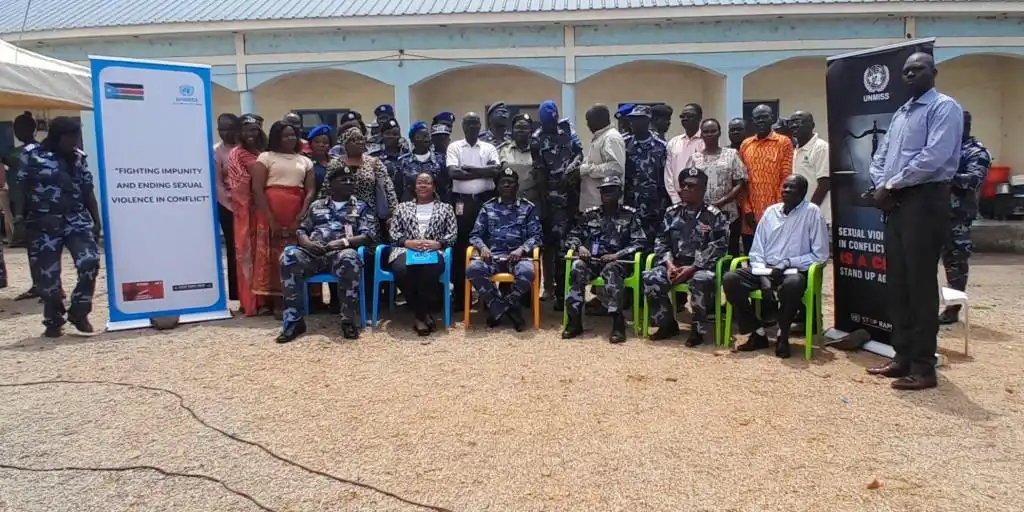
Customary Justice Undermines Rape Victims, Say South Sudan Police/Photo: Radio Miraya
(JUBA) – The South Sudan National Police Service has called for the immediate cessation of using customary courts to resolve sexual violence cases, saying the practice undermines the justice system and denies survivors access to appropriate legal redress.
Speaking during a delayed observance of the International Day for the Elimination of Sexual Violence in Conflict, Deputy Inspector General of Police, Lieutenant General Jal Thomas, emphasised that settling such serious crimes through traditional practices and compensation schemes fails to recognise the lasting psychological trauma inflicted on victims.
“These crimes have lifelong psychological impacts on victims. Yet, in our traditions, they are sometimes treated lightly and resolved under trees with compensation paid as if nothing happened,” he said. “We must revise these practices. Anyone who commits such crimes must face the law. Otherwise, it means those with more cattle can violate others and simply pay their way out.”
In many rural areas of South Sudan, cases of rape and other sexual offences are still handled by traditional leaders, with perpetrators compensating victims’ families, often with livestock. While intended to maintain communal harmony, critics argued that this method prioritises social stability over justice and often silences survivors.
General Thomas urged a nationwide reassessment of cultural norms that continue to marginalise survivors of sexual violence. He highlighted the danger of allowing offenders with wealth or influence to escape prosecution simply by offering compensation, often in the form of cattle.
To provide context, in parts of South Sudan, a typical compensation might involve 20 to 50 cows.
This system, according to the police, commodifies suffering and removes any meaningful consequences for perpetrators.
Major General Sadik Ismail, who heads the police committee on ending sexual violence, reinforced this position. He said the security forces are increasing internal accountability and holding officers and commanders to higher standards.
“When such a crime occurs, we ask the local commander first. If he does not act, we hold him accountable as well,” said Maj. Gen. Ismail. “Commanders are now expected to ensure suspects are arrested and prosecuted through the formal legal process.”
The South Sudanese police leadership reiterated their commitment to breaking the cycle of impunity that has enabled sexual violence, particularly in conflict affected regions. They said strengthening the rule of law is essential, not only for justice but for the healing of survivors and communities.
Although the country continues to grapple with legacy issues from years of conflict, rights organisations and civil society groups have welcomed this shift in police policy. They say formal legal action, rather than customary settlements, is crucial for protecting the rights of women and girls.
Sexual violence has been widely documented during periods of armed conflict and instability in South Sudan. Activists warn that without consistent enforcement of the law, survivors will continue to suffer in silence and perpetrators will remain unpunished.
The police have pledged to expand awareness campaigns and improve training among officers to handle sexual violence cases with sensitivity and urgency.
Discover more from Access Radio Yei News
Subscribe to get the latest posts sent to your email.