




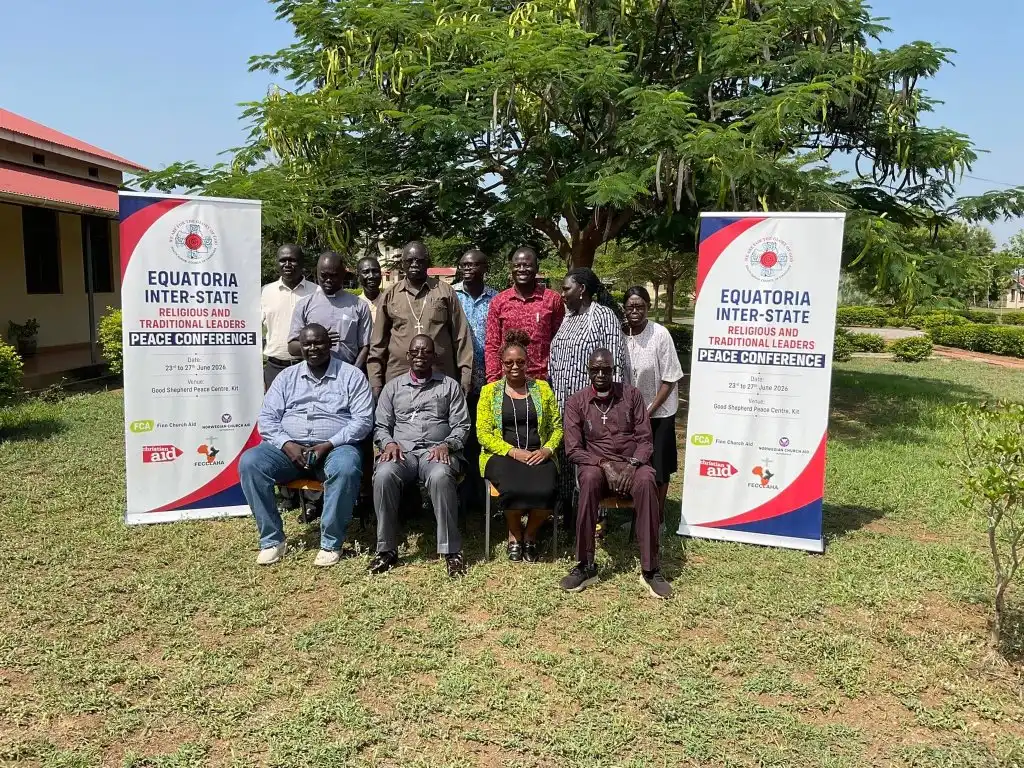
(KIT, CENTRAL EQUATORIA STATE) – Religious and traditional leaders from the Equatoria region have called for the adoption of federalism, security sector reforms and an end to child abduction and cattle related conflicts, following a four day peace conference in Central Equatoria State.
The leaders gathered at the Good Shepherd Peace Centre in Kit from 23 to 26 June 2026. The Equatoria Interstate Non Partisan People to People Peace Conference was held under the South Sudan Council of Churches.
It was supported by peace partners including the Fellowship of Christian Councils and Churches in the Great Lakes and Horn of Africa (FECCLAHA), Christian Aid, Norwegian Church Aid (NCA) and Finn Church Aid (FCA). The meeting was guided by the theme “Nonpartisan People to People Peace Approach”.
In their communiqué, the leaders said they are convinced of the desire of the people of South Sudan to live in peace, harmony and prosperity. They noted the many difficulties standing in the way of peace, stability and development. They acknowledged that current economic hardships are leading many South Sudanese into depression and other unprecedented suffering.
On governance, the conference called for federalism to be adopted as the system of government in the Republic of South Sudan. The leaders said federalism addresses problems linked to the rule of law, institutional empowerment, local customs and aspirations, resource sharing and the promotion of development.
On security, the leaders called for security sector reforms that include equal representation of all South Sudanese in the army, specialised organs and organised forces based on merit and professionalism. They said all civil populations, whether pastoralists, farmers or other community armed groups, should be disarmed without exception.
On land, the conference stated that land is an important asset that must belong to the indigenous people of the area because of ancestral links and ownership. The leaders said development committees should not get involved in the demarcation, distribution and sale of land. They said the role of local government should solely be to regulate issues concerning land based on the 1956 boundaries. All grabbed lands must be considered illegal, they added.
On traditional authorities, the leaders said indigenous traditional authorities must be recognised as custodians of the histories, customs and traditions of the people. They should be respected in all protocols and provided with facilities and all other privileges necessary for their duties. The conference called for roaming chiefs to be banned from exercising illegal demarcations of land and establishing illegal customary law courts in areas beyond their indigenous jurisdictions.
On child abduction, the conference described the phenomenon as a serious concern that must be stopped, criminalised and prosecuted. The leaders called for laws relating to kidnapping to be enacted, promulgated and enforced for broader child protection.
On cattle movement, the leaders said it is a dangerous phenomenon in all dimensions of security and social cohesion in the region. They said cattle movements with the ill intention of disrupting the livelihoods and peace of indigenous communities, with the motive of settling and dislodging them from their ancestral lands, must be abolished and criminalised. The conference also called for the improvement of cattle breeds in the country so that they can bring economic dividends and food security. This would require training of pastoralists for better service delivery.
On marriage, the conference stated that marriage is a relationship between a man and a woman and should be conducted according to local customs that recognise love and consent between the spouses. Marriages should not be treated as business transactions that limit the rights and freedoms of the spouses. Child marriages must be discouraged and criminalised, the leaders said.
On political conduct, the leaders said politicians and community elites who promote manipulation, hate speech, falsehoods, disunity and disputes among people must be exposed, avoided and prosecuted in the courts of law.
On lifestyle, the conference called on South Sudanese to embrace cultures of research, creativity, innovation, food security and development. All chapters of war mongering, revenge, tribal militarisation and idleness must be discouraged, the leaders said.
On tribalism, the conference described it as the catalyst of conflicts and poverty in South Sudan. The leaders said the path to national identity must include the promotion of common languages, positive cultures, sports and social cohesion.
On the constitution, the conference said the best constitution is one that enhances the aspirations of the people of South Sudan as set out in the national anthem. The constitution should be people driven and reflect the history, dignity and cultures of the people. The leaders recommended that the process of constitution making must show transparency and wider consultation and be completed within the planned timeframe.
On elections, the conference said it stands with the people of South Sudan on the need for elections which are long overdue. The leaders said elections will provide an opportunity for citizens to elect capable leaders who will represent them and deliver services according to their aspirations.
The conference recommended that the proposed electoral process should allow equal civic space and freedom of political participation as requirements for good governance and a formal democratic process leading to transparent, free, fair and credible elections. The leaders warned that manipulation of elections against the will of the people would put the country into unprecedented confusion, mistrust and turmoil.
In conclusion, the conference called for an inclusive dialogue that brings together political parties, traditional leaders, faith based groups, civil society organisations and other well wishers as genuine stakeholders in resolving all the problems of South Sudan. The leaders expressed appreciation for the African Union C5 initiative to bring all parties, including hold out groups, to the negotiating table in Tanzania. They called for the points raised in the communiqué to be included in the talks and for other relevant recommendations of the National Dialogue to be adopted for purposes of inclusivity.
The communiqué was signed by Chief Madelena Ihisa Tito, representative of Eastern Equatoria State, Chief Angelino Lodu Lino, representative of Central Equatoria State, Chief Mboribamu Renzi Tombura, representative of Western Equatoria State and Rt. Rev. Jackson Aripa George Gabriel, Assistant Bishop of the Episcopal Diocese of Juba and Chairman of the Equatoria Regional Inter Church Committee, representing the South Sudan Council of Churches.
Discover more from Access Radio®
Subscribe to get the latest posts sent to your email.