








(JUBA) – Peace in South Sudan requires a return to genuine interparty dialogue and cannot be achieved while First Vice President Riek Machar remains under house arrest and on trial, the Troika has said.
U.S. Ambassador Michael J. Adler delivered the statement at the Reconstituted Joint Monitoring and Evaluation Commission (RJMEC) briefing on 2 July 2026. He spoke on behalf of the United States as well as Troika partners Norway and the United Kingdom.
“Peace is our priority in South Sudan,” Ambassador Adler said. “Peace requires a return to genuine interparty dialogue.”
The Ambassador stated that it is farcical to claim that interparty dialogue is taking place when First Vice President Machar, the head of the second largest party to the 2018 peace agreement, is under house arrest and on trial.
He said the 2018 agreement is imperfect, a fact that has been repeatedly shown since its signing. This includes clear signs of a lack of political will by its signatories to implement it.
However, the Ambassador said the agreement remains the basis for the legitimacy of the transitional government. Any changes must be made through dialogue involving all parties to the agreement.
“As we have noted, dialogue cannot be said to be authentically taking place without inclusion of all parties to the agreement, including Riek Machar,” Ambassador Adler said.
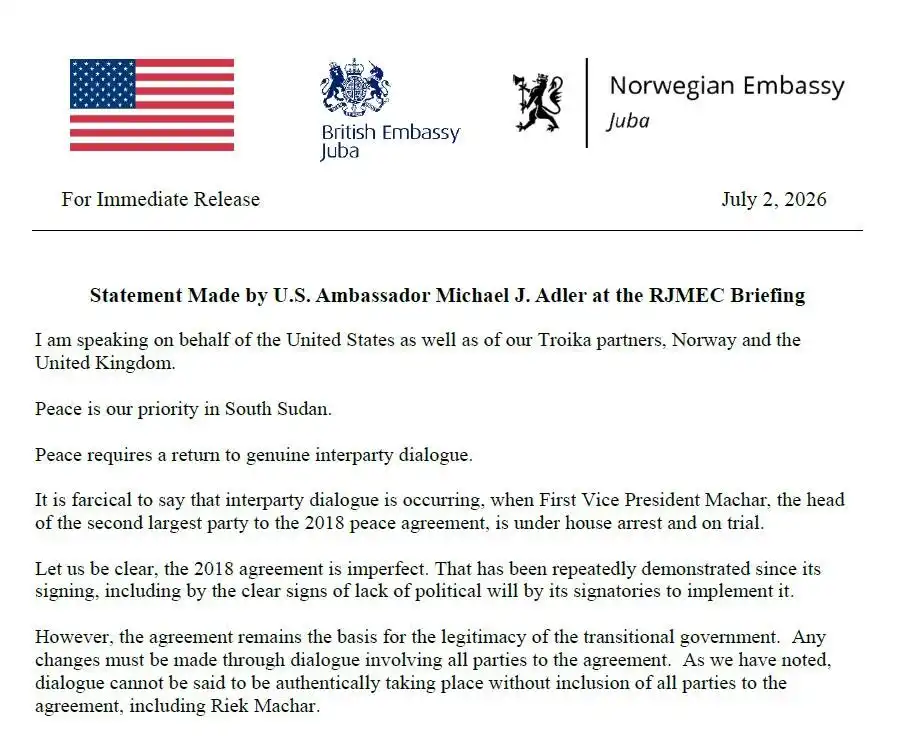
The Troika statement came as the special court hearing the Nasir incident case adjourned proceedings on Friday 3 July until 8 July 2026.
The court had been expected to rule on a prosecution application seeking to require the remaining defendants, including suspended First Vice President Dr Riek Machar, to submit their defence statements in writing rather than present oral testimony.
The court, sitting in its 94th session, was set to rule on the application. However, proceedings were adjourned after the presiding bench announced that panel judge Isaac Puor was unwell.
Prosecutors argue that written defence statements would reduce the court’s transcription workload, save judicial time and help speed up proceedings. They noted that the statements are already available in written form.
Defence lawyers have opposed the application. They argue that the constitutional right of an accused person to present evidence orally in a criminal trial should not be limited in the interest of speed.
They said oral testimony enables judges to hear directly from the accused and assess the credibility of the evidence first hand, an important safeguard of a fair trial.
When the trial resumes on 8 July, the full bench is expected to rule on whether the remaining defendants will present their defence through written statements or oral testimony.
Discover more from Access Radio®
Subscribe to get the latest posts sent to your email.







You must be logged in to post a comment.