













(JUBA, SOUTH SUDAN) – South Sudan’s gross international reserves fell 67.21% in the first quarter of 2025, leaving about five days of import cover, even as the trade deficit narrowed by 383.75% on the back of resumed oil production, according to the Bank of South Sudan’s First Quarter 2025 Macroeconomic Review.
The reserve position is far below the East African Community convergence benchmark of 4.5 months of import cover. The Bank noted that reserves are used to finance the balance of payments and maintain exchange rate stability.
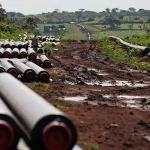
The trade balance turned a small surplus of $83.60 million in the quarter, following the restart of Dar Blend crude oil production, which had been halted for most of 2024 after the pipeline through Sudan was damaged.
Total exports rose 95.97% to $564.19 million, while imports increased 139.85% to $814.77 million. The current account deficit also narrowed sharply, falling 85.13% to $208.75 million from $1.4 billion in the fourth quarter of 2024.
Key Indicators at a Glance
| Indicator | Q1 2025 | Change |
|---|---|---|
| Gross international reserves | 5 days of import cover | Down 67.21% |
| Trade balance | $83.60 million surplus | Improved 383.75% |
| Current account deficit | $208.75 million | Narrowed 85.13% |
| Net oil revenue | SSP 395.02 billion ($54.1 million) | Above target |
| Non oil revenue | SSP 101.43 billion ($13.9 million) | Below target |
| Broad money supply | SSP 3,529.39 billion ($483.5 million) | Up 9.60% |
| Private sector credit | SSP 598.09 billion ($81.9 million) | Up 42.70% |
| Parallel exchange rate | SSP 5,589.34 per US dollar | Depreciated 17.62% |
| Official exchange rate | SSP 4,331.55 per US dollar | Depreciated 25.84% |
| Lending rate | 13.26% | Down from 13.78% |
| Deposit rate | 0.08% | Down from 0.11% |
| Headline inflation | 1.38% | Eased |
| External debt | $2.43 billion | As of Q3 2024 |
Oil Revenue Drives Fiscal Performance
Oil remains the dominant source of government revenue. Net oil revenue reached SSP 395.02 billion ($54.1 million at the parallel rate), above the quarterly target of SSP 284.61 billion.
Total revenue stood at SSP 496.45 billion ($68.0 million), against a quarterly target of SSP 530.83 billion.
Non oil revenue amounted to SSP 101.43 billion ($13.9 million), well below the quarterly target of SSP 246.22 billion. The government has committed to raising non oil revenue to more than 50% of the 2024/2025 budget, but collection remains short of that goal.
Expenditure Falls Far Below Target
Government spending remains constrained. The Ministry of Finance and Planning targeted quarterly expenditure of SSP 526.28 billion, but actual spending reached only SSP 138.34 billion.
Wages and salaries accounted for SSP 51.26 billion, use of goods and services SSP 54.38 billion, transfers to states SSP 23.72 billion, and capital expenditure just SSP 7.60 billion.
The Bank noted significant underspending between July 2024 and March 2025, linked to accrued salary payments, reduced operating expenses and minimal capital spending. It called for prioritisation of spending, particularly the clearance of salary arrears.
Money Supply Grows 9.60%
Broad money supply grew 9.60% in the first quarter of 2025, reaching SSP 3,529.39 billion ($483.5 million). The increase was driven by a 15.33% rise in currency held outside banks, which reached SSP 801.66 billion, and a 7.19% rise in transferable deposits.
The net foreign asset position improved from negative SSP 6,851.97 billion in the fourth quarter of 2024 to negative SSP 6,033.70 billion in the first quarter of 2025, on lower claims on and liabilities to non residents.
The monetary base rose 12.09% to SSP 3,109.66 billion, with currency in circulation increasing 15.37% to SSP 854.53 billion.
Credit to Private Sector Expands 42.70%
Private sector credit grew 42.70% in the first quarter of 2025, following 4.47% growth in the previous quarter. The expansion was led by household services at 397.67%, building and construction at 45.82%, and transport and communication at 35.27%.
Financial services recorded negative credit growth of 39.11%, while mining and quarrying fell 43.51%. The Bank encouraged commercial banks to innovate and improve financial literacy to attract more deposits.
Lending rates averaged 13.26%, down from 13.78% in the fourth quarter of 2024. Deposit rates fell to 0.08% from 0.11%, leaving a spread of 13.18%.
Currency Depreciates 17.62%
The South Sudanese Pound depreciated 17.62% on average against the US dollar in the parallel market in the first quarter of 2025, with one dollar selling at SSP 5,589.34, up from SSP 4,751.81 in the fourth quarter of 2024.
The official rate depreciated 25.84%, with one dollar selling at SSP 4,331.55. The gap between the official and parallel rates narrowed by 3.96%.
The Bank attributed the fluctuations to high demand for scarce dollars.
GDP Growth Projected at 4.0%
The Ministry of Finance and Planning projected real GDP growth of 4.0% for the 2024/2025 fiscal year, boosted by the resumption of oil production.
Headline inflation stood at 1.38% at the end of the first quarter of 2025, while food inflation was negative 0.68%. Monthly headline inflation was higher in the first two months of the quarter at 9.61% and 7.61% respectively, attributed to limited domestic food production.
The Bank said it needs to sustain foreign exchange auctions and treasury bill operations to keep money supply growth within target and contain inflation.
Global and Regional Pressures
The International Monetary Fund revised global growth down to 2.8% in 2025 from 3.3% in the fourth quarter of 2024, citing new trade measures and heightened uncertainty.
Sub Saharan Africa growth is expected to ease to 3.8% in 2025 from 4.0% in 2024. South Sudan’s growth forecast was revised down by 31.5 percentage points for 2025 because of the delay in resuming oil production from the damaged pipeline.
Oil prices fell 3.7% to $74.00 per barrel at the end of the first quarter of 2025, from $76.77 a year earlier, on geopolitical tensions in the Middle East and US tariffs.
The Eastern Africa region is projected to grow 5.4% in 2025, driven by Uganda, Rwanda, Kenya, Ethiopia and Tanzania.
Outstanding External Debt at $2.43 Billion
South Sudan’s outstanding public external debt stood at $2.43 billion as of the third quarter of 2024. This comprised World Bank loans of $104 million, IMF loans of $227 million, African Development Bank loans of $19 million, and other creditors at $2.08 billion.
Domestic debt rose to SSP 10.5 billion in the first quarter of 2025 from SSP 9.5 billion in the fourth quarter of 2024, partly due to revaluation of foreign currency linked loans.
Discover more from Access Radio®
Subscribe to get the latest posts sent to your email.