
























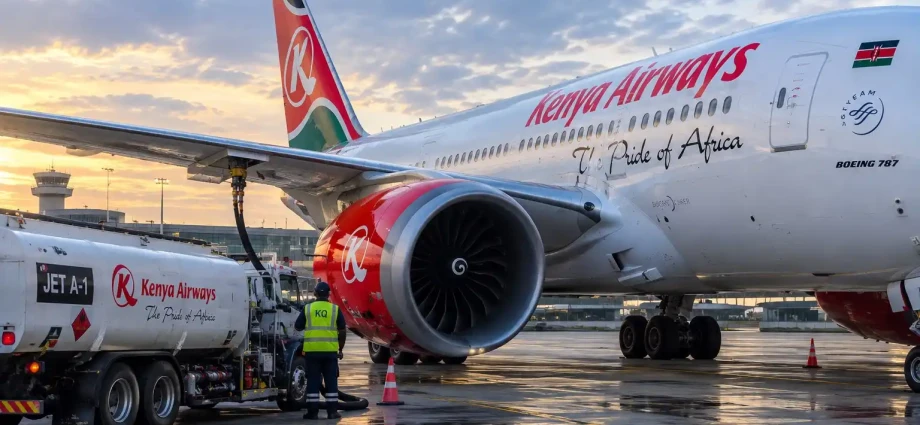
(NAIROBI, KENYA) – French oil multinational Rubis has become the largest seller of jet fuel in Kenya, capturing a 33.6% market share in the year to June 2026, according to data from the Energy and Petroleum Regulatory Authority released in October 2026.
The market share held by the multinational through its local subsidiary, Rubis Energy Kenya, is more than double that of its nearest competitor, Be Energy, which holds 14.01%.
Rubis’s lead is also more than twice the combined 16.66% share held by the other two leading oil multinationals in Kenya, Vivo Energy and TotalEnergies Marketing Kenya.
This is the first time the Energy and Petroleum Regulatory Authority has published market share data for oil marketers in the jet fuel sector.
Demand for jet fuel has grown significantly over the years, prompting Rubis and other oil marketing companies to compete for sales to airlines.
Rubis recently said its jet fuel sales had fallen slightly amid competition from rivals seeking to tap into growing demand for the commodity.
“Volumes in Africa (excluding bitumen) increased by one percent with a declining aviation segment, mainly due to the situation in Kenya, where competition remains fierce,” the French multinational said in its annual report for the year ended December 2025.
The Energy and Petroleum Regulatory Authority did not disclose the volumes of jet fuel sold by Rubis and other oil marketing companies in the year to June 2026.
Overall consumption of jet fuel rose 10% to 734,500 tonnes in the year to December 2025, up from 669,000 tonnes the previous year.
The Kenya National Bureau of Statistics reported in its 2026 Economic Survey that demand for jet fuel decreased by 4.6% to 701,300 tonnes in 2025, with aviation spirit declining by 44.6% to 1,200 tonnes.
Aviation accounted for 13% of total petroleum sales during the period.
Oil marketing companies are capitalising on increased flights by international airlines to Jomo Kenyatta International Airport and Moi International Airport in Mombasa, as well as local budget carriers, to grow sales.
More flights departing from the two airports recently prompted Kenya to import an emergency cargo of jet fuel to avert a shortage that would have affected the two facilities in July this year.
Jomo Kenyatta International Airport has become busier in recent months after emerging as an unexpected transit and refuelling hub following disruptions to regional airspaces and major aviation hubs caused by the Middle East conflict.
Rubis, Be Energy, Hass Petroleum and Stabex International control nearly three quarters of the jet fuel market, or 73.7%.
Hass is the third largest player in the segment with a 13.1% market share, while Stabex is fourth at 12.9%.
Vivo and TotalEnergies hold 11.8% and 4.8% respectively of the jet fuel segment.
The two are the leading oil marketing companies in the overall market for diesel, petrol, kerosene and jet fuel.
Unlike diesel, petrol and illuminating kerosene, Kenya does not regulate the price of jet fuel, leaving market forces to determine the cost of the commodity.
While Rubis leads in the jet fuel business, its rivals are the top sellers of petrol, diesel and kerosene.
Vivo, which retails Shell branded fuel and lubricant products, is the largest oil marketing company in the three petroleum products with a 19.7% market share, followed by Total at 14.12% and Rubis at 14.04%.
The Kenyan Wall Street reported in September 2026 that Rubis Energy Kenya’s revenue rose 19% to €541 million (KES 79 billion / $610 million / GBP 460 million) in the first half of 2026 from €455 million in the same period last year, as stronger commercial and industrial margins helped offset intensifying competition in the petroleum market.
Kenya’s €541 million revenue represented about 31% of the group’s €1.73 billion African revenue during the half.
The revenue growth came despite Rubis losing ground in Kenya’s petroleum market before the start of 2026.
Its market share fell to 13.77% in the six months to December 2025 from 15.43% at June, allowing TotalEnergies to overtake it for second place at 14.01%, while Vivo Energy remained the largest marketer with 20.56%.
Rubis sold 434,601 cubic metres of petroleum products in Kenya during July to December 2025, compared with TotalEnergies’ 441,929 cubic metres and Vivo Energy’s 648,668 cubic metres.
Capital FM reported in March 2026 that the Energy and Petroleum Regulatory Authority’s Biannual Statistics Report 2025/26 showed TotalEnergies climbed to second position with a market share of 14.01%, ahead of Rubis.
In the previous 2024/25 period, Rubis ranked second while TotalEnergies was third.
In a separate development, Kenya Airways and Rubis Energy Kenya signed a memorandum of understanding in May 2026 to develop Africa’s first dedicated sustainable aviation fuel refinery.
The planned facility, to be built near Jomo Kenyatta International Airport in Nairobi, is expected to produce about 32,000 metric tonnes of sustainable aviation fuel annually, with an estimated investment of €60 million to €70 million ($70.5 million to $82.2 million).
The agreement was signed in the presence of Kenya’s President William Ruto and France’s President Emmanuel Macron during the Africa Forward Summit in Nairobi.
The refinery will use modular technology from Dragonfly to process feedstocks including used cooking oils, waste animal fats and other vegetable oils.
George Kamal, acting group chief executive of Kenya Airways, said Jomo Kenyatta International Airport currently consumes 2.9 million litres of jet fuel every day, an amount equal to filling the tanks of 52,727 family cars.
He said switching to sustainable aviation fuel is the most commercially viable, technologically mature and low-risk solution to significantly decarbonise aviation.
Jean-Christian Bergeron, co-managing partner of Rubis and chief executive of Rubis Énergie, said the company’s involvement is consistent with its roadmap to deliver low-carbon energy solutions around the world, with a priority on technology transfer and training for local skills development.
The refinery is expected to come online within 24 months of receiving all required local planning approvals.
Dragonfly chief executive Karl W. Feilder said the critical advantage of the project is that a modular refinery can be sited close to both feedstock and fuel consumers, utilising existing Rubis infrastructure to provide a long-term daily supply of sustainable aviation fuel to Kenya Airways.
The Kenyan Wall Street reported in September 2025 that Rubis’s Kenyan subsidiaries sold about €34.7 million (KES 5.1 billion / $39 million / GBP 30 million) of Kenyan government securities during the first half of 2025, freeing up liquidity that had been tied up as collateral for past fuel subsidy payments since 2024.
Jet fuel costs across East Africa have surged in recent months, with the price of jet fuel in Africa more than doubling to $190 per barrel since the start of the conflict in Iran in February.
Kenya Airways reported a 66% increase in fuel spending in the first six months of the year compared to last year, rising from $131 million to $223 million, accounting for 32% of its operating costs, up from 22%.
RwandAir said its fuel costs had increased by around 70% and that fuel spending now accounted for around 40% of its costs.
The Energy and Petroleum Regulatory Authority reported in its June 2025 statistics report that domestic demand for petroleum products rose by 6.94% to 5.84 million cubic metres, driven largely by a decline in local and international prices and increased economic activity.
Petroleum imports increased by 7.7% to 9.76 million cubic metres, with 55.01% designated for domestic consumption and 44.99% supporting the transit market.
Discover more from Access Radio®
Subscribe to get the latest posts sent to your email.