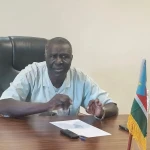









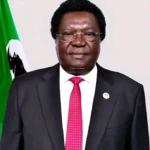




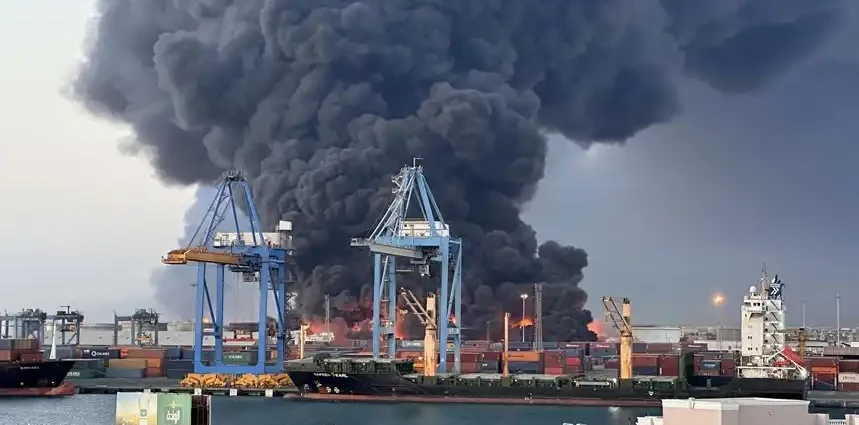
(JUBA) – South Sudan’s oil exports have been severely disrupted by the war in Sudan, with production falling sharply and the country’s main revenue lifeline under threat, Foreign Minister Ramdan Goc has told the United Nations General Assembly.
Addressing the assembly on Thursday, Goc said the conflict between Sudan’s rival military factions has directly damaged South Sudan’s economy, with oil production significantly reduced since April.
He called on the international community to intensify efforts to resolve the Sudan conflict, warning that South Sudan’s economy depends almost entirely on crude oil sales routed through Port Sudan on the Red Sea.
The minister’s remarks came as Sudan’s civil war continues to inflict damage across the region, including on South Sudan’s oil infrastructure. S&P Global Commodity Insights reported in May 2024 that South Sudan was producing 150,000 barrels per day until February of that year, when it declared force majeure on crude loadings from Port Sudan due to a pipeline outage.
Output fell to 70,000 barrels per day in March and 60,000 barrels per day in April, according to the Platts OPEC Survey from S&P Global Commodity Insights.
The World Bank reported in 2026 that the economy contracted by an estimated 23.8% in the 2025 fiscal year as oil output fell sharply from nearly 160,000 barrels per day to an average of 60,000 during the pipeline shutdown.
The African Development Bank reported in July 2026 that oil accounts for more than 80% of South Sudan’s GDP, about 95% of exports, and between 70% and 80% of government budget revenues.
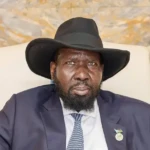
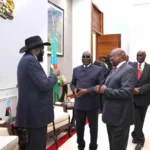
On 16th September, President Salva Kiir and the Chairman of Sudan’s Sovereign Council, Abdel Fattah Al Burhan, discussed resuming oil exports through Sudan following four months of repair work on the oil infrastructure.
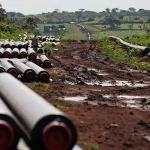
Argus Media reported in September 2024 that around 100,000 barrels per day of Dar Blend had been shut in since February because of ruptures and blockages along the Petrodar pipeline linking oil fields in South Sudan to Sudan’s Red Sea export terminal at Bashayer.
“Given the fact that our economy is entirely reliant on revenue from the sale of our crude oil transported through Port Sudan on the Red Sea, we urge the international community to double its efforts toward resolving the conflict in Sudan,” Goc said.
“We further call for more solidarity with South Sudan as it struggles to overcome and withstand the dire economic impacts created by the conflict in Sudan.”
The fall in oil exports is not the only burden South Sudan carries from the northern conflict. The crisis has driven an influx of people into the country, including refugees and returnees.
The United Nations High Commissioner for Refugees reported in September 2026 that South Sudan hosts 661,529 refugees and asylum seekers across 31 locations nationwide, with Sudanese refugees making up 95% of the total.
Radio Dabanga reported in September 2026 that the Sudan Founding Alliance accused the Sudanese Armed Forces of targeting the pipeline transporting South Sudanese oil through Sudanese territory, particularly in the northern Hamadi area, since 11th September 2026, using drones.
The alliance said the attacks caused pipelines to explode and widespread fires, threatening the safety of facilities and infrastructure and directly harming South Sudan’s vital interests. A force sent to protect engineers and workers was attacked, resulting in the deaths of seven of its members.
Goc praised the work of UN and humanitarian agencies assisting those affected, and said his government strongly supports an IGAD initiative aimed at bringing peace to Sudan.
The Intergovernmental Authority on Development reported in April 2026 that the Quintet, comprising the African Union, IGAD, the League of Arab States, the European Union, and the United Nations, welcomed a joint civilian call for de-escalation and an end to the war, describing it as a significant step toward rebuilding trust and restoring a shared national space for dialogue.
“We also believe that the international community’s support for the victims of the war remains inadequate and unresponsive to the impact on the host communities that are also grappling with serious humanitarian challenges,” Goc said.
Trading Economics reported in July 2026 that inflation in South Sudan stood at 41.6%, having eased from 51.3% in June.
The conflict between the Sudanese Armed Forces, led by General Abdel Fattah Al Burhan, and the Rapid Support Forces, commanded by General Mohamed Hamdan Daglo, erupted on 15th April 2023. It has killed an estimated 150,000 people, displaced millions, and triggered one of the world’s worst humanitarian crises.
On Thursday, 26th September, the army reportedly launched a major offensive involving heavy bombardment in the capital, Khartoum, in an effort to retake areas held by the paramilitary Rapid Support Forces.
Four people were killed during artillery shelling by the RSF after army warplanes carried out air strikes in the capital and north of Khartoum in the biggest such assault in months, according to Al Jazeera.
The Sudanese army is also reported to have taken control of three main bridges, including two linking Omdurman with Khartoum, after attacking military sites belonging to the RSF.
Discover more from Access Radio®
Subscribe to get the latest posts sent to your email.