

















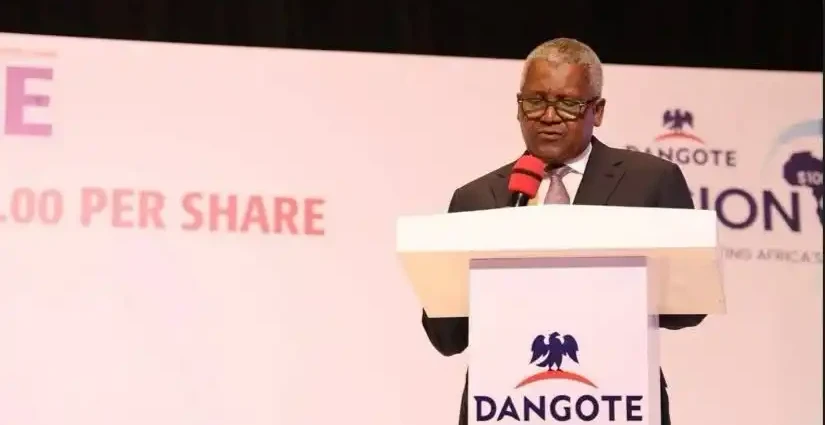
(NAIROBI, KENYA) – Kenyan stockbrokers have lowered the minimum investment for retail investors seeking shares in the Dangote Petroleum Refinery and Petrochemicals initial public offering (IPO), cutting the entry bar from KES 107,000 ($825 / GBP 651) to as low as KES 5,400 ($42 / GBP 33) in a bid to widen participation before the offer closes.
The firms are offering access to the shares through affiliate partners in Nigeria, in a process that runs separately from the global depository receipts (GDR) programme, which will see units equivalent to shares in the IPO list on the Nairobi Securities Exchange (NSE).
Kestrel Capital, which has received no objection from the Capital Markets Authority (CMA) to offer the shares, has not set a floor for investor participation.
Stockbroker Francis Drummond has set its floor for participation at 100 shares, which are selling for KES 54 ($0.42 / GBP 0.33) each, rounding off to a KES 5,400 ($42 / GBP 33) minimum investment.
In contrast, those seeking access to the refinery through the GDR route need a minimum investment of KES 107,000 ($825 / GBP 651).
Kestrel Capital is offering Dangote shares for between KES 53 ($0.41 / GBP 0.32) and KES 56 ($0.43 / GBP 0.34), with the margin from the roughly KES 49 ($0.38 / GBP 0.30) offer price in Nigeria covering foreign exchange costs.
The stockbroker, which is also not charging processing fees to clients, says its access to the IPO is anchored on shares purchased being held in a single omnibus account, which reduces administrative costs.
“We have not set a minimum investment threshold or processing fee as shares ordered by our clients will sit in an omnibus trading account in Nigeria. If we hit the minimum investment threshold set in Nigeria, we would not need to set restrictions on applications,” said Francis Mwangi, Kestrel Capital chief executive officer.
The firms’ low entry level is expected to attract retail and individual investors while undercutting the CMA approved GDR programme, which has established a high entry bar of 2,000 GDR units, each selling at KES 53.50 ($0.41 / GBP 0.32), which rounds off to a minimum investment of KES 107,000 ($825 / GBP 651) before fees.
Seven firms, including CPF Capital & Advisory, SBG Securities and Stanbic Bank Kenya, Francis Drummond, National Bank of Kenya, Sterling Capital, Kestrel Capital and AXYS Investment Bank Limited, were granted a no objection by the CMA to help their clients access the Dangote IPO, which closes on 13th October.
AXYS Investment Bank, however, has a higher investment floor than the GDR programme at KES 259,780 ($2,000 / GBP 1,578) and a two percent processing fee, equivalent to an average $40 or KES 5,195.
SBG Securities is part of an African Distribution Channel alongside Ecobank Transnational Incorporated (ETI), a platform covering eligible African investors described as individuals, corporations, partnerships or trust funds domiciled within Africa but outside Nigeria.
The alternative channels to the GDR programme are set to appeal widely to retail investors seeking a low barrier to enter the IPO before it closes on Wednesday next week.
The GDR programme, whose lead sponsoring broker is Renaissance Capital, offers the most transparent and liquid route to the Dangote IPO, where the listing of units on the Nairobi bourse will bring visibility of the offer to local investors.
In contrast, Kenyan investors will have less visibility from arrangements involving partner brokers in Nigeria, as the trading of Dangote shares will remain on the Nigerian Stock Exchange (NGX) up to the point when the refinery may be cross listed on the Nairobi bourse.
Most Kenyan investors have a lower purchasing power in the capital markets, as shown by the KES 4,818 ($37 / GBP 29) average share purchase via the M-Pesa backed Ziidi Trader platform as of August 2026.
Both offerings of Dangote shares through local brokers and the GDR programme are set to close on 13th October before the subsequent listing of the refinery shares in Nigeria and the depository receipts on the Nairobi bourse.
Discover more from Access Radio®
Subscribe to get the latest posts sent to your email.