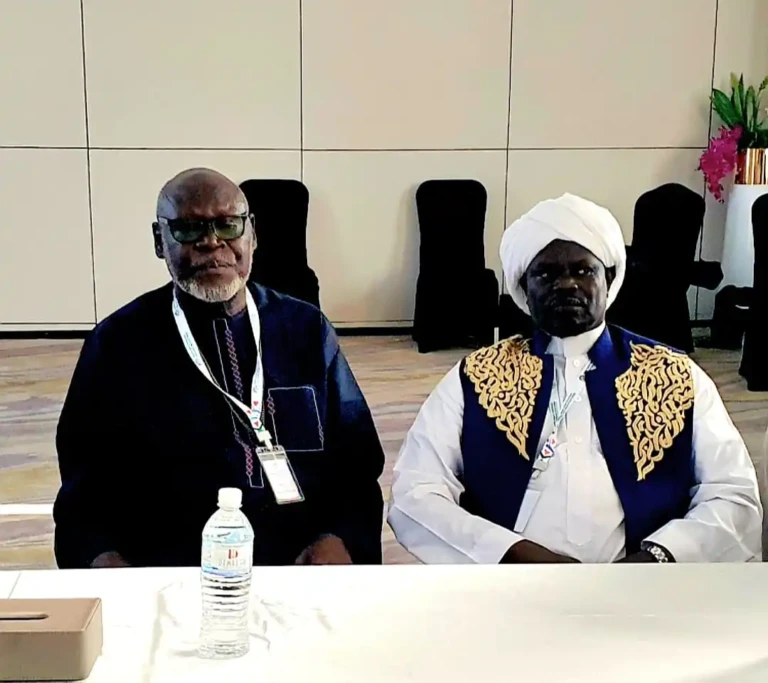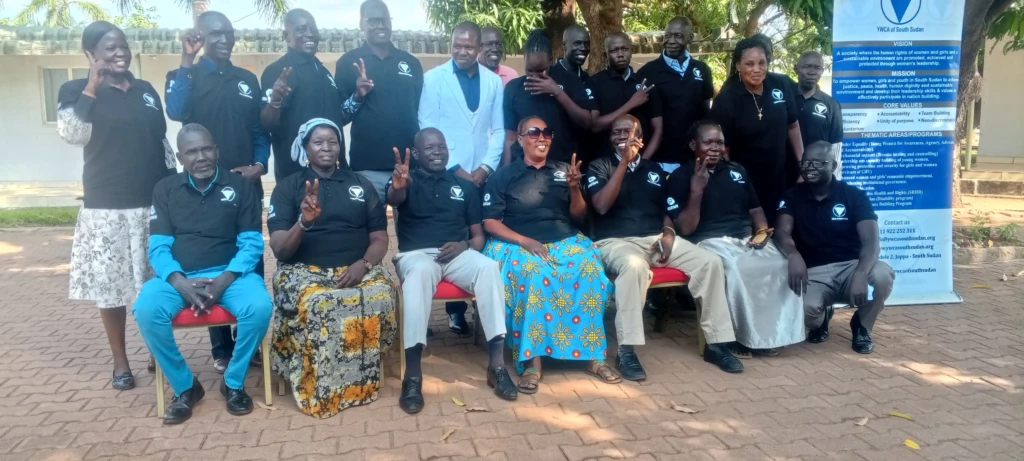
Community peace committee leaders from across Juba pose for a photo
(JUBA)-Every evening, residents in most parts of Juba city make calculations that have little to do with work or family and everything to do with safety. Which road is safe to use? Which neighborhood should be avoided after dark? Will children return home safely from school?
For community leaders like Emmanuel Sacrifice Juma, deputy chairperson of Buluk Extension, Hai Zendia, those questions have become part of the daily lives of most residents in his area.
His area struggles with land disputes, insecurity and growing drug abuse among young people. Some youths gather in groups late into the night, while worried parents and local leaders struggle to keep them away from crime and addiction.
“The number is reducing gradually because of our efforts, but some youths need rehabilitation and medical attention,” Juma said.
Juma revealed the ordeal during a two-day training (June 17-18, 2026) on conflict prevention and peacebuilding that brought together community peace committee leaders from across Juba.
The training, organized by the Young Women Christian Association (YWCA) with support from Oxfam, sought to strengthen grassroots efforts to prevent violence, mediate disputes and improve early warning systems in communities facing insecurity and social tensions.
Participants included over 30 representatives from quarter councils who often serve as the first point of contact when conflicts erupt in neighborhoods.
Speaking at the conclusion of the workshop, training consultant and civil society activist Gizam Moses said the training focused on empowering local leaders who are already trusted by their communities to identify and address conflicts before they escalate into violence.
“We look at the grassroots and try to empower these leaders who have been selected by their communities so that they understand the root causes of conflict, immediate triggers of conflict and how to resolve disputes peacefully,” Moses said.
Throughout the training, participants identified youth gangs commonly known as “niggers,” drug abuse, domestic violence, land disputes and insecurity as some of the most pressing challenges facing communities in Juba.
Areas including Shirikat, Gudele, Munuki and Logo were highlighted as locations where gang-related violence remains a concern.
Moses said community mapping exercises conducted during the training would help residents identify high-risk areas, improve early warning systems and enable security agencies and local leaders to concentrate resources where violence is most likely to occur.
He called on the government and development partners to invest more resources in local peace structures, arguing that community leaders are often the first line of defense against conflict and insecurity.
He said strengthening community peace committees would help improve early warning systems, support community policing efforts and contribute to long-term stability in Juba and beyond.
Participants said the training equipped them with practical skills in conflict analysis, mediation and community engagement. Many pledged to return to their neighborhoods and organize meetings to share the lessons learned.
Rahma Said Farajalla, a quarter council chairperson from Nimra Talata, the workshop was not simply about theory. As a community leader and a woman responsible for helping resolve disputes in her area, she sees firsthand how conflicts affect families, children and livelihoods.
“This workshop has given us knowledge on how to solve problems, listen to people and mediate conflicts fairly,” she said.
The discussions also revealed how broader challenges are fueling local tensions. Participants pointed to years of flooding and climate-related displacement in parts of Upper Nile and Jonglei that have pushed pastoralist communities into the Equatoria region in search of water and pasture, increasing pressure on land and other resources.
Namisio Joy-Bage, a project officer with YWCA’s Rights and Resilience program, said insecurity remains the biggest threat to peace at the community level.
She said local peace committees play an important role in resolving disputes and preventing violence but require additional support and training to be effective.
“Government has to come in strongly with laws and services because many conflicts are linked to lack of schools, hospitals and opportunities for young people,” she said.
She said they will review progress after three months to assess how participants have applied the skills gained during the workshop and to identify areas where additional support may be needed.
Discover more from Access Radio Yei News
Subscribe to get the latest posts sent to your email.