
















(Juba) – South Sudan’s economy is projected to grow by 4.0 percent in 2025, driven largely by hopes of increased oil exports and relative security improvements, according to a new forecast by the African Development Bank (AfDB).
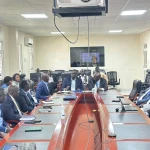
The projections were announced during the launch of the 2025 Country Focus Report on June 25 at the University of Juba.
The African Development Bank emphasized that while the near term growth outlook is modest, the potential for a sharp recovery remains high.
In 2026, the Bank anticipates South Sudan’s Gross Domestic Product (GDP) could grow by as much as 12.1 percent, assuming oil production continues without interruption and the security situation stabilizes, particularly in neighboring Sudan. Sudan provides the pipeline infrastructure critical to South Sudan’s oil exports.
AfDB officials, including Professor Robert Mayom Deng, Vice Chancellor of the University of Juba, and Hoth Tot Chany, Senior National Country Economist for the Bank, participated in the report launch. Chany explained that the Bank revised its earlier projections following South Sudan’s announcement in January 2025 of resumed oil output.
“If oil production remains steady and stability supports agricultural productivity, we foresee economic growth reaching 12.1 percent next year,” Chany said. He added that the current year’s estimated 4.0 percent growth reflects positive trends despite earlier challenges.
The new report comes after a difficult fiscal period. South Sudan’s real GDP contracted by 27.6 percent in 2023/2024, a sharp drop from the 2.5 percent growth recorded in 2022/2023. The downturn was primarily caused by damage to Sudan’s pipeline during conflict, which disrupted South Sudan’s oil exports, its primary source of revenue.
The report, titled “Making South Sudan’s Capital Work for South Sudan’s Development,” explores the country’s dependency on oil, which accounts for more than 50 percent of GDP, about 80 percent of exports, and over 90 percent of public revenue.
This level of dependence, the Bank argues, makes South Sudan’s economy highly vulnerable to external shocks and limits efforts to diversify the economy and expand the tax base.
To sustain growth, the AfDB made several policy recommendations.
The report called on the government to prioritize peacebuilding and political dialogue, particularly in the lead-up to national elections, which the Bank urges should be fair, transparent, and credible. Stability, it argues, is essential to address the country’s fragility and unlock long-term development.
Another recommendation focuses on macroeconomic reform. The Bank suggests that domestic resource mobilization should be strengthened through expanding the tax base and closing revenue leakages.
It also urged the Bank of South Sudan to build strong foreign exchange reserves to limit exchange rate volatility and external economic pressure, which in turn could help curb inflation.
Inflation remains a significant concern. In 2023/2024, consumer prices rose by 65.6 percent and are projected to remain elevated at 65.0 percent in the 2024/2025 fiscal year. This persistent inflation is largely linked to the rapid depreciation of the South Sudanese Pound.
As of December 2024, the local currency had lost about 340 percent of its value on the parallel market. This depreciation also contributed to an increase in the money supply, which rose by over 200 percent in October 2024 compared to the same period a year earlier.
Despite these macroeconomic challenges, there were some signs of improvement in agriculture. The report noted that the area of land harvested increased by 6.2 percent in 2024, while crop yields grew by 8.3 percent. These gains helped offset, in part, the broader decline in economic activity due to oil related disruptions and reduced trade caused by regional instability.
The report also placed strong emphasis on improving institutional capacity and governance. It stresses that effective management of South Sudan’s natural capital, especially oil, requires functional institutions, rule of law, and transparent financial systems. Without these, the country risks missing the opportunity to transform its natural wealth into sustainable development.
The African Development Bank’s message is cautiously optimistic. South Sudan has the potential for significant growth if peace holds, oil flows steadily, and reforms are effectively implemented.
These goals, the Bank concludes, will require coordination among government agencies, international partners, and the private sector.
South Sudan’s fiscal and monetary challenges remain tied closely to its dependency on oil revenues, which are mainly priced in U.S. dollars. Exchange rate stability will be crucial not only to curb inflation but also to protect the purchasing power of South Sudanese citizens, many of whom are already facing high living costs.
Observers say the AfDB’s findings offer a roadmap for recovery, but only if current political and economic risks are carefully managed, as the government prepares for future elections and continues efforts to stabilize the economy.
Discover more from Access Radio®
Subscribe to get the latest posts sent to your email.