























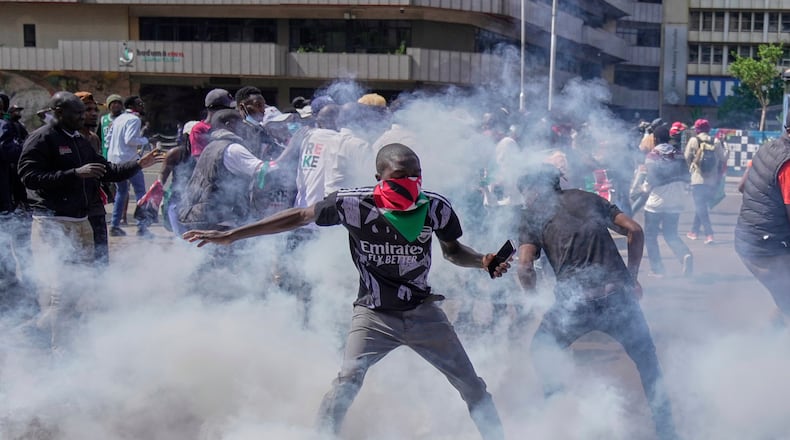
(Nairobi) – At least nine people were confirmed dead, more than 400 injured, and 61 arrested following widespread protests in Kenya on Wednesday, marking the first anniversary of the June 25, 2024, anti-government demonstrations. The events, which were triggered last year by youth protesters storming Parliament, reignited tensions across the country, drawing attention from neighboring states, including South Sudan, where citizens are watching developments with growing concern.
According to the Kenya National Commission on Human Rights (KNCHR), a state-funded body, eight of the fatalities occurred across six counties and were caused by gunshot wounds. Two people were killed in Machakos and Makueni each, while one death was reported in each of the counties of Kiambu, Nakuru, and Nyandarua. A ninth fatality was confirmed by Kenya Power after a security guard at its Nairobi headquarters was shot during the protests.
Dr. Raymond Nyeris, KNCHR vice chairperson, said that over 400 people were injured in the unrest, including demonstrators, journalists, and police officers. Of these, 83 were referred for specialized treatment and eight had sustained gunshot wounds. He also cited the use of “excessive force” by security personnel, including live bullets, rubber bullets, and water cannons.
The death of Mr. Fred Wamale Wanyonyi, a guard employed by Hatari Security, occurred outside Stima Plaza, the headquarters of Kenya Power, around 4:30 p.m. He was pronounced dead upon arrival at Mama Lucy Kibaki Hospital.
Jointly, the Law Society of Kenya, the Kenya Medical Association, and the Police Reforms Working Group warned that the final casualty numbers may rise. Their statement acknowledged that some data was still being compiled and verified by medical professionals and human rights groups.
Across Kenya, the protests were both a memorial to the estimated 60 people killed during last year’s demonstrations and a new wave of resistance against perceived injustices. Kenyatta National Hospital reported receiving 90 people with injuries, including several from gunfire. A staff member said the count was expected to increase as more casualties arrived.
The demonstrations reached at least 27 counties, including Nairobi, Kisumu, Mombasa, Nakuru, Kiambu, and Eldoret. Protesters used burning tires and rocks to barricade roads, halting transportation, particularly along major highways like the Mombasa-Nairobi route.
Two protesters died from chest gunshot wounds in Emali, Makueni County. Kilome Nursing Home confirmed they were declared dead on arrival. In Machakos, two more deaths were reported at Matuu Sub-County and Matuu Mission Hospitals after protesters tried to storm the local police station. Hospital officials said some of the wounded were in critical condition.
In Nyandarua, protests turned violent after police shot a protester carrying a Kenyan flag near a police station. An enraged crowd later set fire to the local assistant county commissioner’s office. The protester died at JM Memorial Hospital.
Eldoret’s Moi Teaching and Referral Hospital received 13 patients by late afternoon, with most injuries described as minor. In Nyeri and Karatina, additional injuries and one fatality were reported. In Kiambu, a man was fatally shot during an alleged attempt to storm Juja Police Station, although police say the source of the gunfire remains unclear.
In Nyahururu, peaceful protests were disrupted when alleged government-hired goons clashed with demonstrators. A youth leader in Laikipia accused authorities of enabling the attack, calling for investigations into the groups’ coordination with police.
Online, the protests were amplified by hashtags such as #SiriNiNumbers and #OccupyStatehouse2025, which dominated social media trends, with the former ranking fourth globally and featuring in over 7.7 million posts in just six hours.
The scenes in Kenya are drawing attention in neighboring countries like South Sudan, where civil society groups and youth movements have increasingly turned to social media to express solidarity and raise concerns over regional governance and state accountability.
With casualties mounting and calls for justice intensifying, Kenya’s civil society and international observers warn that further unrest is possible unless grievances are addressed.
Discover more from Access Radio®
Subscribe to get the latest posts sent to your email.