
























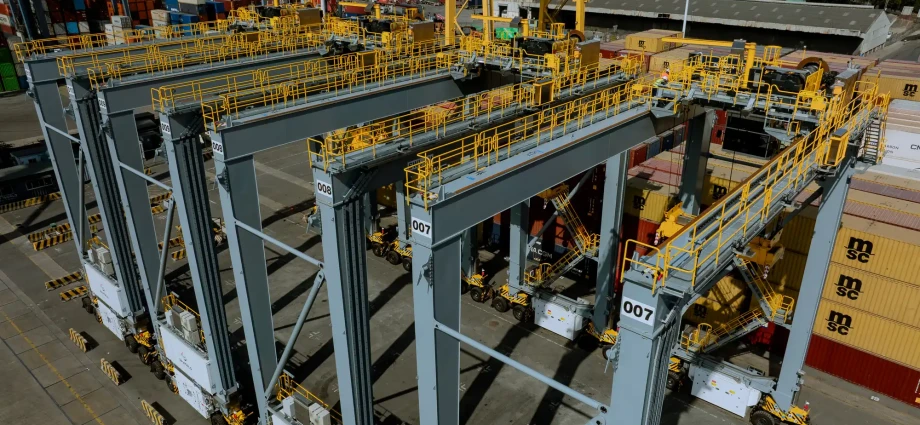
(DAR ES SALAAM, TANZANIA) – Dar es Salaam Port has recorded a sharp rise in transit cargo, reinforcing Tanzania’s position as a key gateway to inland Africa and intensifying competition among regional trade corridors serving major markets such as the Democratic Republic of Congo (DRC), Rwanda and Zambia.
According to port statistics, transit cargo passing through Dar es Salaam increased by 17 per cent to 14.61 million tonnes during the 2025/26 financial year, driven largely by growing trade flows to the DRC and Rwanda.
The DRC remained the port’s largest transit market, accounting for more than half of the cargo volume. Shipments destined for the mineral-rich country rose by 30 per cent to 7.77 million tonnes, while Rwanda-bound cargo grew by 24 per cent to 2.18 million tonnes. Zambia handled 3.41 million tonnes, despite recording a five per cent decline.
Overall cargo throughput at Dar es Salaam Port climbed by 21.5 per cent to 33.71 million tonnes, reflecting Tanzania’s continued investment in maritime infrastructure and inland logistics networks linking the Indian Ocean to regional markets.
Analysts say the figures highlight the growing strategic importance of trade corridors connecting East Africa to the resource-rich hinterlands of Central and Southern Africa.
The significance extends beyond cargo volumes. The DRC and Zambia form one of the world’s most important copper-producing regions, supplying a mineral increasingly in demand for electricity networks, electric vehicles and other clean-energy technologies.
To improve efficiency, Tanzania has expanded port infrastructure while strengthening connections through roads, railways and inland logistics facilities. At Terminal 1 of Dar es Salaam Port, global logistics firm DP World has operated berths zero to seven since April 2024 under a 30-year concession agreement.
The company says it has invested heavily in equipment and infrastructure improvements, helping to accelerate cargo handling. Terminal 1 processed 44,001 twenty-foot equivalent units (TEUs) in May 2026, representing a 57 per cent increase compared to the same period last year and more than three times the volume recorded in May 2024.
DP World also reports that cargo discharge times have fallen dramatically, from more than 300 hours before the concession began to less than 28 hours.
Despite the gains at the port, experts note that efficient maritime operations alone will not determine the region’s preferred trade route. The cost and reliability of moving goods beyond the harbour remain critical factors.
Once cargo leaves Dar es Salaam, rail capacity, trucking availability, customs procedures and border clearance times become decisive in determining overall transport costs and delivery schedules.
To address these challenges, Tanzania is advancing major infrastructure projects, including the Standard Gauge Railway (SGR) and the Kwala Dry Port, which is expected to handle approximately 300,000 containers annually while providing logistics services for neighbouring countries.
However, Dar es Salaam continues to face competition from alternative regional corridors serving the Copperbelt and Central African markets. Cargo owners and logistics firms increasingly compare routes based not only on port efficiency but also on the total cost, speed and predictability of transporting goods from port to final destination.
The latest cargo growth figures indicate that Tanzania is strengthening its role in regional trade. Yet industry observers say the long-term success of the Dar es Salaam corridor will depend on whether improvements at the port can be matched by seamless transport links to mines, factories, warehouses and consumers across inland Africa.
Discover more from Access Radio®
Subscribe to get the latest posts sent to your email.